"All hunting stories are the same," said Clovis; "just as all Turf stories are the same, and all--" "My hunting story isn't a bit like any you've ever heard," said the Baroness. Esme
I've been fond of the short stories of H.H. Munro, aka Saki, since I discovered them in my college library. During the hours I should have been studying, partying, or (probably) reading books that actually were part of my English classes, I read him instead. There was something mesmerizing about those highly artificial stories, so many of them just little constructions around a wasp sting from his constant narrators, Clovis Sangrail and Reginald.
Saki's characters tended not to go near horses - knowing, apparently, that horses can reduce the most elegantly self-possesed human to sweating, ineffectual mania in under thirty seconds. In the story The Rogue, however, a horse plays a pivotal role in a newlywed's life. And in Esme, Saki makes a wholly unique contribution to the genre of fox-hunting fiction. Esme is also featured in a collection of horse stories, Classic Horses Stories: Fourteen Timeless Horse Tales, edited by Steven D. Price.
"It sounds a queer proceeding to ask for a horse back when you've just sold him," said Mrs. Mullet, "but something must be done, and done at once. The man is not used to horses, and I believe I told him it was as quiet as a lamb. After all, lambs go kicking and twisting about as if they were demented, don't they?" The Rogue
Links The Brogue- Beasts And Super Beasts Esme - The Chronicles Of Clovis
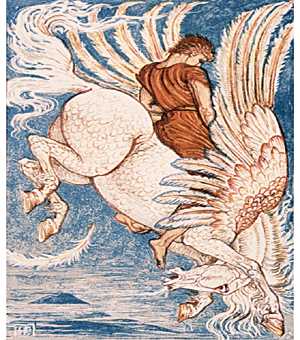
I was slinking along the Young Adult section of the library, trying not to look creepy and old, when I spotted a brand new fanatasy novel whose cover was not largely black, did not feature an expressionless virgin and whose title did not appear in a red ribbon floating across the heroine's cloud of violently floating hair. In short, a novel which did not appear to be about the Undead, the Fey, or the like. It was vaguely green, but grass green, not the poison green of a book about demons or wizards. My gaze lingered, and then my eyes widened as I took in the title.
I haven't read Pegasus yet, but I have high hopes. The pedigree is impeccable. McKinley's been doing fantasy for years; I particularly liked her two visits to the Beauty and the Beast tale, Beauty (1978) and Rose Daughter (1997). She's no Bella/Harry opportunist. Her vampire story, Sunshine (2003), was one of the better recent takes on the genre.
On the FAQ section of her website: I used to say that the only strong attraction reality ever had for me was horses and horseback riding.
So she appears to be ideally suited to tackle the flying horse legend.
As they entered the partially harvested, moonlit cornfield, Cricket snorted and swung her head from side to side. She eyed with alarm the stalks of dried corn that stood like skeletons of their former selves. The wind sent the dead leaves into a frenzy of rustling, like the clicking of miniature bones. Dustin pressed his heels into the mare's sides, but she refused to move faster than a nervous prance. "Haunted Hayride" in the anthology A Horse For All Seasons by Sheila Kelly Welch (1994)
With a jack o'lantern glowing out front and a surprising number of children trick-or-treating to the house (including one girl dressed as an equestrian! true story!), I am driven to a holiday posting. However, I do not have a suitable review and, inexplicably, horse books with a Halloween theme are thin on the ground, outside series books. In the short story quoted above, however, I hit a perfect connection to my last post; in Welch's tale, a teenage hayride goes awry when the organizer's little brother swipes her barrel-racing mare and stages a little Headless Horseman action.
Halloween Mr. McFadden's Halloween by Rumer Godden (1975) Phantom Rider: Ghost Horse by Janni Lee Simner Phantom Rider: The Haunted Trail by Janni Lee Simner(1996) Phantom Rider: Ghost Vision by Janni Lee Simner(1996) The Saddle Club: Horse Magic (#47) by Bonnie Bryant (1995) The Saddle Club: Ghost Rider (#24) by Bonnie Bryant (1992) The Great Pumpkin Ride by Laura Hesse (2004) Riding Academy: Mary Beth's Haunted Ride by Alison Hart (1994) Pony Tails: Corey And The Spooky Pony by Bonnie Bryant (1996) Animal Ark: Pony In A Pumpkin Patch (#49) by Ben M. Baglio (2006)
Ghost Stories with Horse Mystery Horse by Margaret Goff Clark (1972) Gypsy And The Moonstone Stallion by Sharon Wagner (1980) The Mystery Of The Crimson Ghost by Phyllis A. Whitney (1969) Sydney's Ghost by Carol Iden (1969) The Ghost Pony by Lynn Hall (1978) (aka The Mystery Of Pony Hollow) Ghost Horse by George Edward Stanley (2000)
In college, I had a job as a witch at a Halloween hayride. We witches lurked in a dark corner of woods and when a wagon meandered past, we charged out and pretended to attack, screaming and cackling and clawing at the customers. Around 9pm, the kids and adolescents were replaced by teens and young adults, often drunk, who fought back with screaming insults and beer bottles. The tractor would carry them away before anyone got mauled, chugging off through the low, wet fields to do battle with the zombies next door. On busy nights, we'd be chasing one wagon as the next appeared behind us, and we'd have to roar back to the cauldron (which periodically caught on fire), on weekends the local cops would drive through, grinning, to round up an ornerier-than-usual customer. On slow nights, we'd walk down the road to visit with the neighbors - Freddy Krueger, Frankenstein's Monster, the zombies, the mad scientist and his victim. It paid minimum wage, but all in all, it was a highly satisfying job. The only downside was that I was on the opposite side of the property from the Headless Horseman, whose black horse I sometimes glimpsed as I drove into the parking lot.
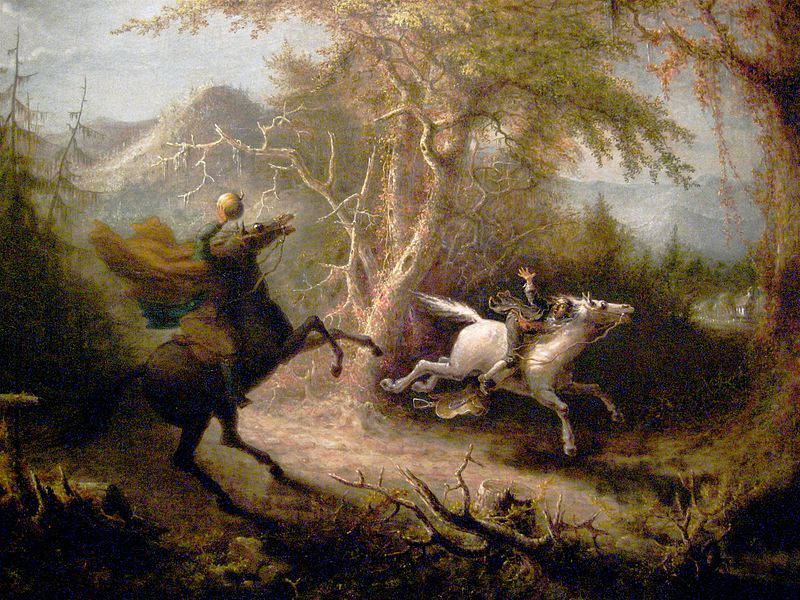
The Headless Horseman Pursuing Ichabod Crane, by John Quidor (1801-1881) Oil, 26 7/8 x 33 7/8 in., Smithsonian American Art Museum. Public domain via Wikimedia commons
The animal he bestrode was a broken down plow horse that had outlived almost everything but his viciousness He was gaunt and shagged with a ewe neck and a head like a hammer his rusty mane and tail were tangled and knotted with burrs one eye had lost its pupil and was glaring and spectral but the other had the gleam of a genuine devil in it Still he must have had fire and mettle in his day if we may judge from his name which was Gunpowder.
I was standing at a bus stop in Philadelphia once, waiting dreamily for my ever-tardy public transit choice to heave into view through a spring rain, when an unusually designed truck stopped in front of me for a red light. And a small elephant looked out the half-open side door. I gazed in at the elephant, the elephant gazed out at the bus stop, the light changed, and we all went back to our lives. The circus, obviously, was in town.
I've never really liked circuses; the massive Ringling operation, the folksy modern-day tent shows, and the animal-less Cirque all leave me cold. That is, the shows leave me cold. The idea of being part of the circus, on the other hand, is fabulous. All that color and drama to take you away from drab and sordid reality. From Toby Tyler to The Greatest Show On Earth, I've always been a sucker for a circus story.
Plus, classic circus stories are like Westerns; even when they're bad, they have horses.
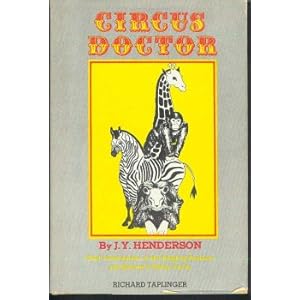
Circus Doctor
J.Y. Henderson, told to Richard Taplinger
1951, Little, Brown and Company
... the circus's biggest preoccupation was with its horses: Ringling Brothers had a fortune tied up in what was undoubtedly the most beautiful collection of horses in the world.They wanted everything possible done for the rest of their animals too, but experience had taught them that they couldn't expect that to be too much.
In September, 1941, John Ringling North called a young veterinarian and offered him a job. The vet, Henderson, was a partner in a mixed small/large animal practice in Louisiana, and suffering from the physical effects of anthrax.Fascinated by the idea of the circus and believing that the recent advances in veterinary medicine mean a chance to pioneer in the field of exotic animal care, he accepted.
In Ringling Brothers - Barnum & Bailey's winter quarters in Sarasota, Henderson is wary of his new, dangerous charges and takes comfort in the familiar:
On three sides of us there were open stalls, and on the fourth were box stalls where the most favored horses were kept.In the immediate center of the corral were patches of grass decorated with palm trees and a large watering trough...I examined the broad-beamed Percherons, smaller neat hackneys, smart American saddle horses, wild Arabians, the standard-bred horses, stockinged Clydesdales, and Andalusians.
Of course, Henderson treats the wild animals: the bears, which he discovers almost always need worming; the big cats, which seem to have a downright equine knack for strange accidents; a chocolate-loving hippo; and the elephants, who have a tendency to become footsore through walking on concrete so often.He and his wife even raise a particularly winning baby leopard, Sweetheart.His secret to treating animals seems to have been an exacting interest in details.He watches every horse act from the sidelines, noting each small incident like a horse bumping a leg on the ring, and treating the slight bruise before it can get bad.Fascinated by the wild animals, he spends time getting to know them and their trainers.
The busiest place in the world is not a beehive.It is not found by watching the ways of an ant, nor is it an army preparing for an invasion.The busiest place on earth is the grounds of a gigantic circus, two weeks before hitting the road for an eight-month season.
In that first year, with the value of vaccinations still in question, Henderson confidently tells the Norths that vaccinating the circus's 200+ horses will prevent the annual losses to shipping fever and sleeping sickness.That was a success.His attempt to halter two llamas for the parade was not.
While the pen boys stood there laughing, the two llamas chased me all over the pen.I was chastened and emerged unvictorious after being sprayed by both of them from head to foot.
Then there's the frankly alarming camel story, which I don't particularly care to relate in detail.Suffice it to say, camels appear to be extremely open-minded about personal matters most animals tend to regard with a great deal of jealousy.Henderson, perhaps because of this or because camels are just uncooperative patients, says:
I'd gladly walk a mile to keep from operating on a camel.
A year after he joins the circus, Henderson has an experience which irrevocably changes the way he views animals.On an August morning in Cleveland, a flash fire sweeps the menagerie tent, leaving animals dead, dying and badly hurt.Shocked by the aftermath, Henderson is impressed with both the stoicism of the badly hurt creatures and the willingness of those uninjured to go on with the show that night.
I knew then there is something in animal make-up akin to greatness in men.It is not just their size or their swiftness; their fierceness or their power.There is an inner nobility and a kinship to what is enduring in nature.
This is a essentially a collection of moments connected by quick throwaway lines about non-circus life.Henderson went into WWII in 1944 and served until 1946, rejoing the circus with his new wife, Martha, an aerialist.A few pages sum up their courtship, a paragraph goes to the war.A serviceable style, which supports but doesn't elevate the interesting stories, but which allows the author's humor and likeability to come through, and gives space to his passionate and sometimes elequent conclusions.Obviously dated, and some comments are a little depressing, as when he notes that the circus's horses are never put out into a pasture to graze.
And finally, it is a testament to the power of horses to do truly odd, arguably idiotic things that in a book filled with escaping lions, runaway giraffes and very angry gorillas, many of the most memorable mishaps have to do with the horses.A saddle horse, waiting on the ramp into MadisonSquareGarden, gets her hoof caught in her mouth.A liberty stallion decides to climb the bleachers, reaching the top row before deciding this was a bad idea.An absent-minded parade horse bumps into the tiger's cage and nearly gets scalped.
Henderson was apparently friendly with the Klebergs of the King Ranch, and their vet J.K. Northway, who recommended him to North.Ringling Bros., often bought King Ranch Quarter Horses for their show.





 Posts
Posts

