Tuesday, August 20, 2013

The Golden Pasture (1986)


The Golden Pasture
Joyce Carol Thomas, il.???
1986, Scholastic POINT

“I still say that Indian woman would still be here if you knew how to cooperate sometimes and learned how to show a little affection.  Black folks and Cherokees have been marrying and getting along for as long as I can remember.  What’s your problem?”

The uneasy relationship between Gray Jefferson and his grown son, Samuel, is laid out in that comment.  Samuel has just come to Gray’s Oklahoma  ranch, Golden Pasture with his newborn son, Carlton Lee.  In the first, startling chapters, Samuel had stolen the infant from his Cherokee mother, Rose Branch, after she gives birth in the winter woods, and Gray clearly suspects that his son’s to blame for whatever separated mother and child.  Carlton will never see his mother again, but he forms a strong bond with his grandfather almost from the moment he’s placed in his arms. 

12 years later, Carlton Lee is spending another summer at Golden Pasture, enjoying the company of his easygoing, story-telling grandfather and riding horses.  The only unsatisfactory spots are visits by his brooding father, his nagging desire to ride in the Boley Rodeo, and his curiosity over one remote pasture he’s forbidden to enter.  When an accident forces Carl Lee to enter this area, he finds a beautiful Appaloosa and, indirectly, a clue to his father’s past.  As he works to restore Cloudy to health, his grandfather tells him the story of Samuel and his wild horse, and their fate.

“Once, your daddy loved a horse.  I should’ve let him keep the horse after we caught him, but I wanted to show him off in that darn rodeo.  He was a king, that horse.”

Carl Lee understands the story – of Thunderfoot the wild horse, of Samuel the wild teenager who responded to the wild stallion, and of Hellhound, the brutal bronc rider who couldn’t resist the challenge of Thunderfoot’s reputation for putting cowboys on the ground.  But he doesn’t understand the last piece until history repeats itself at the Boley Rodeo. 

A father-son story centered on a horse, with a writing style that reads like a storyteller’s voice.  The author wrote several books set near Ponca City, where she grew up, and some feature Carl Lee. 
 
Series
Marked By Fire
Bright Shadow
House of Light


Links


Saturday, August 10, 2013

Saddle Patrol (1970)


Saddle Patrol
Carl Henry Rathjen, il. Cliff Schule
1970, Western Publishing (A Whitman Book)

13-year-old Mike Flynn is on a long visit with his cousin, Terry Stevens, who lives in a unique horse-friendly development in Wisconsin.  On his first night, he goes to check on his horse, Duke, and stumbles across a mystery.  When he and Terry investigate, they uncover a larger can of worms involving an unfriendly neighbor, mysterious tensions between horse-owners and farmers, and the troubling worry that Terry’s father, the local police chief, could lose his job.  Mike, a preternaturally level-headed kid, bounces between investigating the heck out of the mystery and soberly assuring Terry's policeman father that he'll leave the investigating to the proper authorities.  On one of the "No sir, I will leave policing the the adults" days, he helps his cousin deliver newspapers - on horseback! - and enters into a simmering feud with older newsboy Rod Baxter - which leads to a vital clue!  And back we go to investigation. Assisting in the plot is the town police dog, recovering at the Stevens household from an injury.  

An underwritten, plot-heavy mystery with flat characters and drawn-out action scenes.  And another of the awkward Whitman Books, with their horrible illustrations and fragile, yellowing pages and binding.


Carl Henry Rathjen
Rathjen was one of several writers who produced a volume in the Trixie Belden series. He also wrote two horse stories which appeared in The Boys’ Life Book Of Horse Stories (1963), “The Curb Bit” and “Sacrifice Spurs.” He also had a horse story in The American Girl Book of Sports Stories (1965), “Trophy For Sheri.”

Cliff Schule
Illustrated a number of Whitman books, including the horse anthology Golden Prize.


Odd Facts/Possibilities

Claybank  -
This was an unfamiliar term to me, so I googled around.  From the usage in the book, it clearly means Duke is a shade of chestnut, but I was interested in how it was used as a stand-alone adjective:

Mike touched Duke with his heels.  The claybank surged in outflanking pursuit.

It turns out claybank is a description of a red dun – a dilute chestnut the color of a clay bank.   Like many of the color obsessions, it seems to be heavily associated with the West and classically Western horses.  The other main horse in the story, Terry’s horse Wanderer, is a black blanket Appaloosa. 
   
From Wikipedia:
Red dun, also called claybank or fox dun, horses do not have black points, as there is no black on the horse to be affected. Instead, the points and primitive markings are a darker shade of red than the coat. Genetically, the horse has an underlying chesnut coat color, acted upon by the dun gene.”

Horse Colors website

Mustangs4US


Comanche
The lone survivor of Custer’s command at Little Big Horn was a gelding named Comanche.  The horse, badly wounded, survived and became an emblem of the battle to the Army, which retired him with orders he never be ridden again.  The argument over Comanche’s color illustrates the flexibility of color terminology, particularly before the genetics were understood*.  Usually called a bay, Comanche is also sometimes described as a claybank; while current usage reserves the term for a dun without black, it seems that it was once used as a general way to describe any unusually light brown horse.

Kansas University’s Comanche Exhibit

*to be clear, color genetics – dilutes, champagnes, etc. - are still not understood by me.

Lincoln
And, to round it out, and because the Lincoln assassination adds interest to any topic, an old folk song “Booth Killed Lincoln” calls Booth’s getaway horse a claybank:

The people all excited then, cried everyone, "A hand!"
Cried all the people near, "For God’ s sake, save that man!"
Then Booth ran back with boot and spur across the back stage floor,
He mounts that trusty claybank mare, all saddled at the door.

J. Wilkes Booth, in his last play, all dressed in broadcloth deep
He gallops down the alleyway, I hear those horses feet;
Poor Lincoln then was heard to say, and all has gone to rest,
"Of all the actors in this town, I loved Wilkes Booth the best.


Saturday, August 3, 2013

Odds and Ends

Various items while I finish up some reviews.


Shark Week!!!!!!!!!!!!
Tomorrow, The Discovery Channel's shameless annual sharkfest kicks off.  This does not constitute a significant cross-over with horse books, as horses generally stay on land.  However...


... didn't you just know the exception to the shark/horse rule would be Walter Farley?  Sharks menace Tena in The Horse That Swam Away and nearly eat Alec (once again shipwrecked) in The Black Stallion and Flame.  In the latter book, the Black is also attacked by a vampire bat, pictured above on the 1970's paperback cover looking as big as a turkey vulture.   


Contest?
Anyone want a contest where you can win vintage (cough) horse books?  I have some rattling around that I keep meaning to do a contest for, but I wasn't sure if anyone would be interested.  I mean, these are books you can get at Amazon for a penny.  On the plus side, they'd be free and the only requirement to enter would be a comment on future reviews.  

Updates
Also, I once reviewed a picture book, Horses by Blanche Chenery Perrin.  Recently, I came across a comics blog which shows the entire (well, it was a Little Golden Book) book.  Well worth a look - I really like Hamilton Greene's illustrations.

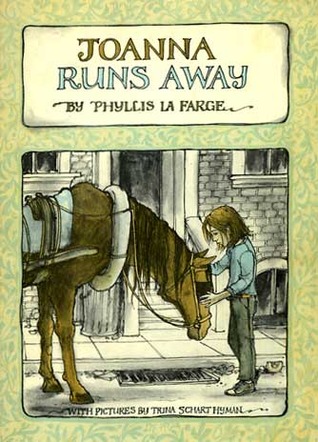
And my sole horsey purchase at a used booksale today.  Cute - Trina Schart Hyman's illustrations are always eye-catching.


Saturday, May 11, 2013

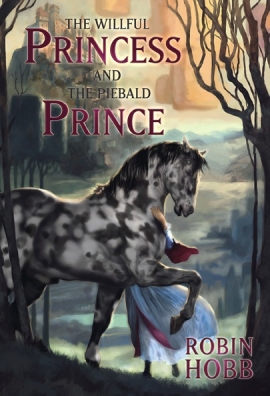
The Wilful Princess And The Piebald Prince (2013)


The Wilful Princess And The Piebald Prince
Robin Hobb, il. Jon Foster
2013, Subterranean Press

For something a little different.  This book stands alone quite nicely, but also functions as a prequel of sorts to the author’s popular fantasy series, much of it centering on a dragon-plagued land called the Six Duchies, and the royal Farseer family that rules it when they're not busy killing each other.  I’ve read most of the books – there are currently 13 – and generally liked them.  They’re decent fantasy novels based on characters and convincingly portray a complicated fantasy world.  This novella is much shorter and concentrated than the sprawling enormity of the rest of the series, but has many of the same elements – strong and often unlikeable women, mysterious men, royal squabbles, high fantasy tone and a tendency toward unexpected bloodbaths. 

The backstory for this installment is that in the main series, there’s a violent dislike for one branch of magic ability.  The Wit is the ability to bond and communicate with animals in a mystic way; Witted folk can literally speak with animals.  When this book begins, years before the later books, being Witted is considered acceptable.  When the next book (Assasin’s Apprentice) in the series opens, the Wit is regarded as corrupt and evil.  In this book, it’s explained how that prejudice came to be.  It starts with a Queen-In-Waiting named Caution.  Who is, to put it mildly, quite unlike her name.  At 20, she’s refused to marry, refused to learn anything about ruling, and generally is vexing her indulgent parents.  And then the horse fair opens.  

Now among his ware this odd trader had a spotted horse – not dappled nor speckled, mind you, but blotted in great ugly spots, like a fruit that has taken blight, or a poorly-dyed blanket, or a milk cow.  Black-and-white he was, with a rolling blue eye on one side of his head and a dark staring one on the other.  Big was this beast, and a stud, unruly of temper, screaming out his challenges to any stallion that came near and snuffing and stamping after every passing mare.

Caution sees the horse, and the Witted slave named Lostler who is the only one who can control him.  She buys horse and man, and installs them in the royal stable, and you can tell where this is going.  But Caution's predictable disaster is not where the story ends. 

The story is narrated by Felicity, the plain daughter of an ambitious wet nurse.  Maneuvered into place as the playmate and personal maid of Caution, she has grown to love her.  She has little choice; taken from her family at a young age and instructed harshly by her mother on how to please a fickle princess, Felicity has virtually no one but Caution.  The princess, all unknowing, is Felicity’s family, friends and lover, all in one.  Their betrayals of each other will be impressive, especially given that Caution really doesn’t recognize that she is betraying her – for how can a princess betray a servant?

Honestly, not all that horsey.  It is interesting, though, how Hobb uses the horse to rachet up the sexual tension between the heir and the groom; as the maid watches her mistress flirt with ruin.


Robin Hobb’s Six Duchies/The Elderlings novels
Assassin’s Apprentice
Royal Assassin
Assassin’s Quest
Ship of Magic
The Mad Ship
Ship of Destiny
Fool’s Errand
The Golden Fool
Fool’s Fate
Dragon Keeper
Dragon Haven
City of Dragons
Blood of Dragons

About the Author
Margaret Astrid Lindholm Ogden (1952 - )
aka Megan Lindholm


Links
Subterranean Press
 Tor Books - excerpt


Wednesday, April 3, 2013

Odds and ends

Am I alone in using the digital camera as a way to remember books?  Forget scribbling the name on a scrap of paper, now you can just whip out the cell phone or camera and snap a photo.  Also, while we're on the topics of using bookstores - am I alone in finding a rather smug pleasure in finding egregiously misplaced books which some previous browser hastily stuck into a shelf?  Cat care in the computer section, poetry with the car manuals, I lovingly extract them and pile them happily on the nearest bench so they can eventually rejoin their brethren.


This is the scene in February, mere moments before I took a spectacular fall.  All that snow cunningly conceals a puddle which I KNEW was there, as it's there 9 months of the year, but somehow forgot just long enough to step onto its slickly iced surface and go flying.  My experience was caught on video, as I had the camera turned to movie at the time, but I think I'll just not share that.  It's a blur as the camera makes a lovely arc through the air, and then, as it lands a short distance from my suddenly prone body,  a lot of groaning, some slightly dramatic clutching of the ground, and a final, belated shot of the dog making a sortie back to see what was taking me so long. 


The puddle complex in warmer times. 

Which is why I am rather impatient for spring.  I love cold weather, but when snow conspires with ice to maim, you really don't need a horse to hurt yourself.  It's funny; I have the typical fear issues with riding that most sane adults have, but my worst falls have been sans horse.  Which is something I reflected on after another ice slide a few years ago.  As I lay with my head in the street, watching a SEPTA bus heaving toward my skull, I resolved to never be afraid on horseback again.  I didn't think of making a more sensible pledge, and resolving to move to a climate without ice.


A winter pansy, looking beaten but unbowed.  Granted, it was a mild winter, but I'm still impressed by their survival.  Also the decorative cabbage.


My gardens have always exhibited a lack of overall cohesion.  I believe my harsher critics think this is due to some stupendous lack of vision, but they're wrong.  I'm well aware that a deep purple pansy and a pale lavender cabbage are not natural compliments.  The thing is, I like both of them.  I'm an intensely personal gardener; that it pleases my eye is the goal.