Saturday, March 26, 2011

A Day At The LBJ Ranch (1965)


A Day At The LBJ Ranch
Sam Savitt, author and illustrator
1965, Random House

"If we do meet the President, what should I say?"

Jackie and Dennis have been chosen to represent the Girl Scouts and the Boy Scouts on a visit to President Lyndon Baines Johnson's ranch in Texas. The two are understandably nervous about meeting their famous host, but before that moment arrives, they are taken on a tour of the ranch, riding Quarter Horses and learning about the history of the area and the Johnson family, as well as getting an inside look at the backstage of life at the Texas White House.

When the little calf tried to get back to its mother, the gray spun around almost faster than their eyes could follow. The horse kept facing the calf, quickly flanking it away from the others.

The kids, both enthusiastic riders, are impressed with the Western horses, and Jackie tries her hand at cutting - with mixed results.


Ultimately, a pleasant book and nicely illustrated, but a bit odd. It functions largely as a 'this is our President' tutorial, in a reader-friendly fictional format, with plenty of Texas history and landscape thrown in. The characters are flat and the brief story is not very involving, but the situation is so unique and the art is so Savitt that I think I'll hang onto my copy. Savitt, normally a decent writer, seems unable to maintain that quality in this very short, simpler format, and the style is wooden as a result.


Links
Sam Savitt website
de Grummond Children's Literature Collection - Savitt
Johnson City (presidental hometown) Chamber of Commerce
Lyndon B. Johnson National Historical Park
Life Magazine photo of LBJ on his Tennessee Walking Horse mare, Lady B

Friday, February 25, 2011

Hopalong Cassidy And The Bar 20 Cowboy (1952)

When I was cleaning out the attic, I came across a dead squirrel, cardboard boxes from mercantile establishments no longer in existence (R.I.P., Lit Brothers, Wanamakers and Strawbridge & Clothier) and several long-lost books. Including this Little Golden Book.


E.M. Beecher, il. Sahula-Dycke
1952, Simon and Schuster
Based on characters created by Clarence E. Mulford

Starting in the 1920s, Clarence E. Mulford wrote 28 Western novels starring a heroic cowboy (Louis L'Amour would write another four). Paramount brought the character to the screen in 1935, using silent film actor William Boyd. 65 films later, Hopalong Cassidy was an industry that spawned a radio show, television programs and personal appearances by Boyd and his horse Topper.


Now, I never saw the movies or TV series, but I loved these illustrations. Also, the idea of sneaking up on a horse and capturing it for my very own.

And then branding it neatly with my own initials.


Looking at these illustrations again reminds me how I used to love pintos. Now they call them paints and they're muscular Quarter Horse types, but I grew up reading stories where pintos were always scrawny little Indian ponies, who lived wild and free on the wide prairies.


About the author.
I couldn't find anything about E.M. Beecher, but my real interest was in the artist, anyway. Ignantz Sahula-Dycke (1900-1982) was born in Austria, emigrated to the U.S. and eventually specialized in art of the Southwest.


Links
Hopalong Cassidy website
Wikipedia - Hopalong Cassidy
B-Westerns about Topper
Fusco Four Modern - Sahula-Dycke
Toklak website - Sahula-Dycke
Mulford's books at Fantastic Fiction
Wikipedia on Lit Bros.
- on Wanamaker's
- on Strawbridge & Clothier

Sunday, February 20, 2011

Cactus Kevin (1965)


Cactus Kevin
B. Holland Heck, il. Lorence Bjorklund
1965, The World Publishing Company

"A fellow on a farm has to have a horse."

It's 1944, and Kevin Bryson's parents have just moved the family from Tulsa to a farm (his dad, working at the Douglas Aircraft Company, a war industry, is presumably exempt from the draft). He's never been on a horse, and he has trouble remembering his new chores, but he loves being out in the country and once he sees a neighbor's palomino gelding, he's in love. The neighbor, a brat named Freddie, is notorious for mishandling his horse, which further inflames Kevin. But apart from the Bryson's lack of money, there's a problem in that the former city boy is fighting his parents' doubt that he is responsible enough to have a horse. From leaving the calf without water to teaching the rooster to fight, Kevin seems to constantly give his father a reason to be exasperated.


The family has problems apart from his wanting a pony they can't afford. Kevin's mother is struggling to maintain a primitive, rural house, while his father is discouraged by the sizable task of bringing a neglected farm back to life. Their worst problem is their well is dry, something the previous owner failed to mention. As the family slowly moves forward, digging a new well, buying calves, and learning the ins and outs of tractor control, Kevin is often too busy dealing with the new demands of farm life to long for a horse.

It rained again that night, making the ground muddier than ever. The Brysons scarcely knew how to cope with the mud. Dad said, "That's the blackest, stickiest, contrariest stuff I ever saw." Kevin thought both Dad and Mom seemed a little defeated by it. A variety of thin, straggly grass grew in the yard, but it didn't keep them out of the mud as their lawn grass in town had done. This grass pulled up by the roots with the mud, helping to hold the mud together that much tighter.

Kevin eventually gets his chance, Freddie gets his comeuppance, and the family triumphs over their early adversity. A very solid story about a family, but not particularly horsey as most of the book is about the family's struggles with the farm. I'm a sucker for tales about Black Angus calves, tractors and digging wells, but I was a bit disappointed, especially as the few really horsey scenes are flat. There is one hair-raising accident scene, which you can see coming the first time Freddie uses his horse to race the school bus.


Like most farm books, it does an excellent job of showing the dangerous side of farming; Kevin, who rides out the above rear without turning a hair, is terrified when his father's first ride on the new tractor nearly turns to tragedy.


Heck also does a nice job of presenting realistic characters. The mother isn't saintly or silly; the little sister is bratty but strong (and Kevin swings between "Awww, sis" reactions and doing things like building her the snow horse above), and the father can get discouraged and unreasonable. Perhaps reflecting the isolation of their ranch, there are few characters outside the family, apart from old Wrangler Slim, an old man living nearby who befriends them when Kevin, early on, wanders into a cactus patch, and who gives him his nickname.


About the Author
Bessie Holland Heck based this book on her own family's adventures, and Kevin was based on her son Ronald. She was married with five children, a freelance writer who lived in Tulsa and, during World War II, on an acreage just like the Bryson family's.


Other books
Millie (1961) (il. Mary Stevens)
The Hopeful Years (1964) (il. Lorence Bjorklund)
The Year At Boggy (1966) (il. Paul Frame) - adventures of farm workers' children
Captain Pete (1967) (il. Robert Cassell)
Golden Arrow (1981) - also horsey (il. Charles Robinson) (Scribner)
Cave-In At Mason's Mine (il., Charles Robinson) (Encore Editions)
Danger On The Homestead (1991) (Levite Of Apache Publishing)
Taming The Homestead (sequel to above)

The books after 1981 appear to have been published by a very small regional publisher, and little information is available on them. All the books appear to be juvenile fiction.

Links
de Grummond Collection
Ponymad Booklovers blog on Heck
Jane Badger Books about Heck
Catoosa, OK

Tuesday, February 15, 2011

Horse books that aren't

Looks promising, doesn't it? A girl, a horse, waves. And to be accurate, there are horses in the plot.


13-year-old Alyssa lost her parents to a hurricane when she was ten, and has been mute ever since. She can't even tell her beloved grandfather that she would really rather he not sell their small riding stable on the Gulf Coast and send her to live with her disapproving aunt Melinda. Despite the presence of several factors I can't stand - including a harpy aunt with a saintly husband, a heroine presented as an eternal and pretty victim, and a male relative with a bit o' dialect from t'old country - it's a well-written book. Just not a horse book.

The most famous horse-book-that-isn't has to be The Red Pony, Steinbeck's bloody Valentine for the pony set.


In writing this blog, I've been flexible in my definition of 'pony book,' largely because the genre as traditionally defined is a small, starved portion of American children's books. We just do not have many books about adolescent girls riding in gymkhanas. So I've been easy-going, as if you haven't noticed. My guideline has been, if it whinnies or brays, it can go in. And I'm a sucker for illustration, so I've included picture books, and then I'm still recovering from a childhood of Walter Farley and C.W. Anderson so a disproportionate amount of racing posts have snuck in. So where does the line go for 'horse book' and 'not-a-horse-book'?

I'd say it goes between books which treat the horse as a symbol (of girlish childhood, of freedom, etc.) and those that treat them as actual horses. I suppose the former isn't terribly unreasonable. Though it remains a mystery to me, there are a lot of people who grew up around horses and essentially thought of them as if they were bikes; fun, somewhat useful, a nice thing to have, if you're a good person you take good care of it, but nothing to get all excited about.

Though, when you cut it like that, was National Velvet a horse book? Was My Friend Flicka? Both focused on their dreamy heroes and to a large extent the horses, although they took a satisfying chunk of center stage, were symbols of dreams and growth. Can a book that attempts to be more than genre writing be a horse book, or are horse books, a mini-genre themselves, too simplistic?


What do you think?

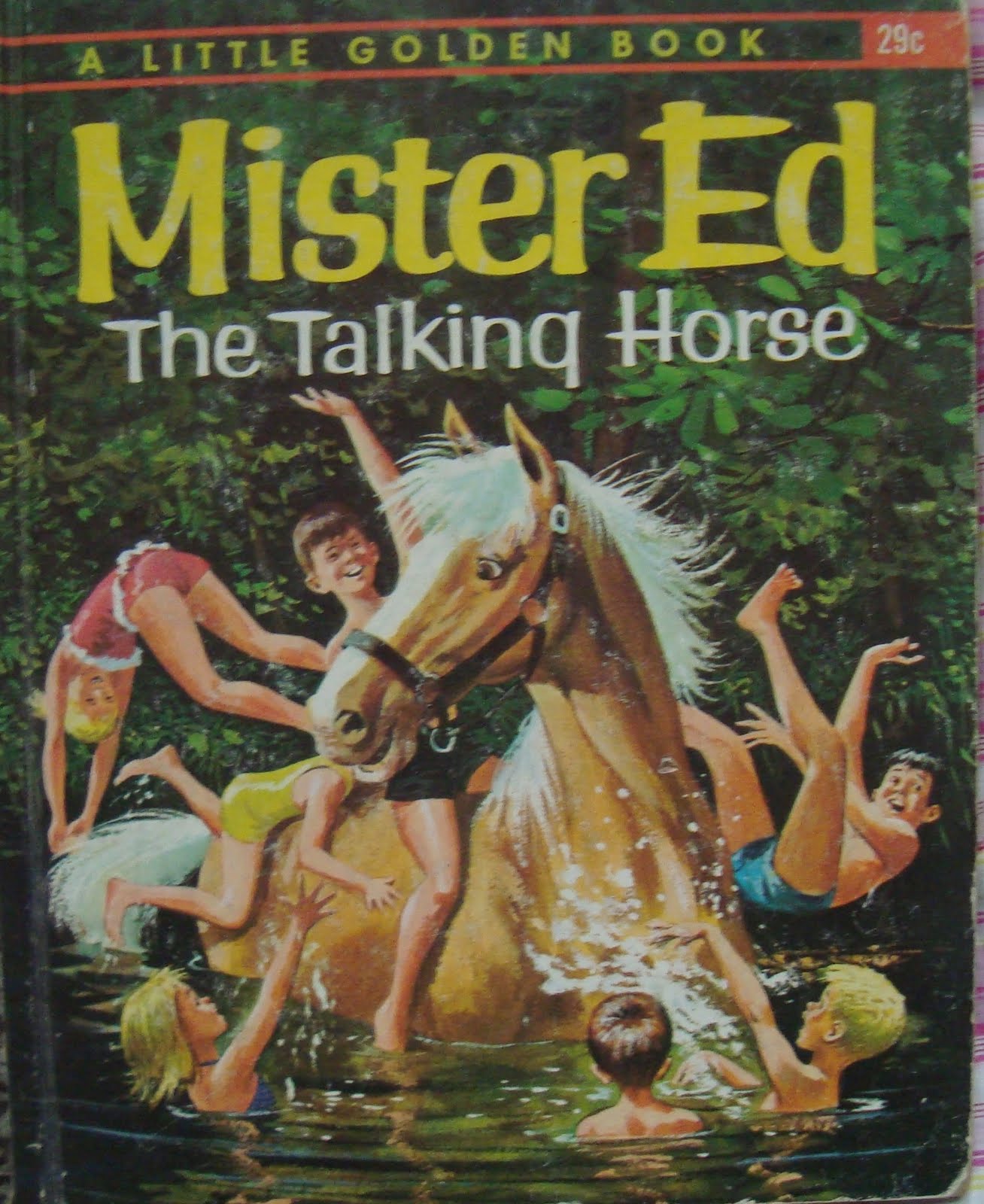
Mister Ed, The Talking Horse (1962)

Mister Ed, The Talking Horse
Barbara Shook Hazen, il. Mel Crawford
1962, Golden Press

Ed, having taken possession of the phone once again, invites an entire orphanage to visit for the weekend.


I really have no excuse for this, except that I have always loved the illustrations in this Little Golden Book.


In talking horse-related topics, the cheerful memoir Alan Young (aka Wiiiiiilbuuuur!) published in 1995, Mister Ed And Me, is worth a read.


About the author
1930-
Hazen was born in Ohio, worked in publishing and then began freelancing as a children's writer after her son was born. She has written over fifty books.

About the illustrator
1925-
Canadian-born Crawford seems to be one of the most popular illustrators for Little Golden Books. As the post on the blog Illustration Station shows, Crawford did another equine-themed Little Golden Book in 1958's Fury Takes The Jump.

Links
Barbara Shook Hazen's website
de Grummond Collection on Hazen
Illustration Station
Mel Crawford's blog
Mel Crawford on a website about collecting Little Golden Books
Alan Young's website