Friday, September 21, 2012

Riding lessons

 
I began taking riding lessons a few years ago, having belatedly realized that now that I had a real, grownup job and my own money, I could finally get myself on a horse. As of this moment, I can now (mostly) tack up, retrieve a horse from a field despite said horse's uncanny ability to vanish behind a blade of grass, mount with the use of a mounting block (I did once achieve the top of the horse sans the block, but it was ugly and I believe it may have traumatized me, the horse and my instructor equally), stay aboard reasonably well and in something vaguely resembling equestrian form at a walk and a trot, and, with varying degrees of success, canter. I can even, when my blood is up and my instructor is armed with a longe whip, canter cross-rails.     

This only took years, a pair of extremely long-suffering horses and a series of valiant instructors to accomplish.  But somehow, this direct experience of the awkward fact that riding a horse is actual hard work doesn't detract from my enjoyment of horse books and their untutored but effective little riders whose light hands, natural seat and perfect sympathy with all things equine are forever being applauded by hard-bitten stablemen and wealthy old ladies who just happen to need someone to ride Corinthian in the upcoming show. I think the reason for my lack of resentment is that I secretly believe that had I had the opportunity when I was 10, I'd have ridden off across the moors on my magnificent wild stallion too, just like all the fictional heroines who never experience a moment's qualm but enjoy a Perfect Bond with their pony. The Perfect Bond issue must be why so few horse books even mention lessons. I've trolled through many books, searching out lesson scenes, and have not found much. The most vivid and realistic actually were in memoirs, and I'm going to have a different post about them. Below are some of the fictional lessons I've found, and a particularly appealing illustration from Panky In The Saddle. Panky's expression is just as confident and happy as my own felt, the first time I attempted to transfer myself from the top of a mounting block to the top of a horse.

Panky In The Saddle interior


As the colt trotted steadily around he would release the mane and raise his arms to shoulder level. Then, to the moorman's orders, he would swing them from side to side, up and down, together and alternately; touch his toes, one at a time and both together; lie back until his head touched the pony's rump; then he would pick up the reins, knotted over the colt's withers, and take a gentle contact, learning how to keep his wrists supple so that his hands could move with the colt's head and keep a "living" contact on the bit.
The White Colt by David Rook (1967)

Yes, this is exactly how my lessons are: private longe sessions where I do gymnastics. I find Jinny more appealing:

"I don't know enough," Jinny thought desperately. "I don't know the right things to do. My riding just isn't good enough. I've never had any proper lessons and sitting on Bramble isn't really riding. Not like riding Shantih. Books are no good. Reading them it all sounds so easy, but they're no use when I'm flying through the air."
A Devil To Ride by Patricia Leitch (1976)

But then again, Jinny and her Shantih are also a bit off-puttingly magical, albeit in a grungy, socially aware 1970's way.

Try as she might, Marcy could not find the posting rhythm again and slithered and slathered around in the saddle.
Everyday Friends by Lucy Diggs (1986)

Now that's more like it. Then there's the competitive kids and their trainers:

"You will please to remember you are not a passenger. You will please to remember that you are the boss. You will grip. You will be firm in the saddle. You will hold the reins and give your commands with authority."
The Colonel And Me by John W. Chambers (1985)

Ruth heard the hollow booming noise of falling poles behind her like the tolling of a funeral bell; she turned Toad in a large, wild circle, in no hurry to face Mrs. Meredith again, and certainly not Peter. The Team by K.M. Peyton (1975)

At first everything I did was wrong. "Sit down in the saddle. Sink into it. Let your weight sink down through your heels. Relax. Relax. How can you be with your horse unless you can feel its every breath through your seat?" I couldn't answer. I could only nod and go on trying.
Dream Of Fair Horses aka The Fields Of Praise by Patricia Leitch (1975)
Far more common than the official lesson are heroines who wing it, often with the help of what their horsey bibles have said.

 
I remembered what the Book said. I pressed in with my heels. At the same time, I lifted the reins in one hand. "Tluck-tluck," I said, feeling foolish. The result was amazing! Bonny lurched forward. Between those ears, I saw the meadows rolling slowly toward and under us. We were walking straight ahead.
The Rain-Cloud Pony by Anne Eliot Crompton (1977)

Or, even worse, just their instinct.

But she felt a piece of fear, realizing that her skill at riding was nothing and she had no saddle or bridle to give her superiority.  All that held the mare to her was a slim leather line; if she broke loose, not yet knowing home and barn, the mare could canter for miles and be lost and gone.
Blueberry by Helga Sandburg (1963)

And always, of course, the horse is the ultimate teacher.

But she had never yet felt reins that had a trained mouth at the end of them, and as she cantered up the slope of the sunny field with the brow of the hill and the height of the sky in front of her, Sir Pericles taught her in three minutes what she had not known existed.  Her scraggy, childish fingers obtained results at a pressure.  The living canter bent to right or left at her touch.  He handed her the glory of command.
National Velvet by Enid Bagnold (1935)


Wednesday, August 8, 2012

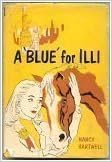
A "Blue" For Illi (1954)

A Blue For Illi (aka Blue Ribbon Winner)
Nancy Hartwell, il. Don Sibley
1954, Henry Holt and Company

This was the spot where Illi liked to linger when the horses were out.  She would stand, one foot on the rail, watching the sleek brown or gray or black bodies stretch and arch themselves in the most beautiful curves in the world.  Was there anything more beautiful than a horse in action?  Was there a better friend anywhere than a horse?

Ilona Horvath is standing in the lushness of Philadelphia's furthest suburbs, the gently rolling countryside of Chester County.  Walking down a country lane past a sprawling gentleman's farm, on her way to the snug home of her second family, the Enrights, Illi's come a strange, hard distance from her birth in Budapest.  The daughter of an artist and a lawyer, Illi had a happy childhood and even when she was evacuated from the city in 1943, she continued briefly to enjoy a snug middle-class existence at the government horse farm (the real Kisber Stud, which bred Thoroughbreds) her grandfather manages first for the Hungarians and then for the invading Germans.  But by 1945, the 10-year-old's childhood is effectively over.  Her parents, opposed to the invading Germans, have been arrested and killed, her grandfather dies protecting her from a guard, her older brother's run off to join the guerrillas, and even her beloved young stallion Vidam must be left behind.  As Illi expresses it herself in an essay, that was the end of the "well-bred little girl;" she "became one of the lost children of Europe who lived from day to day in the best way they could."  In her case, she fought her way to a Children's Camp for displaced people and managed to get herself sent to America, to be a companion for a middle-class couple's disabled daughter, Ardis.  She's been there a while now, and is happy enough, but still unsure of her future.

Whew.  To her credit, Hartwell presents all that information in a natural way and not in the action-packed paragraph format I just used. 

Back to the horses.  With the unerring instinct of many a less-challenged horsey heroine, Illi manages to attract admiration and help from the Major, one of those invaluable wealthy neighbors who own quality horses and has a soft spot for spunky girls.  Illi and falls in love with his horse Hocus-Pocus (aka Pokey), who reminds her painfully of the lost Vidam.

She was standing in the road, trying to get up her courage, when she heard the soft clop of hoofs and looked up the lane to see Neal coming along on Rockabye and leading another horse, a stud colt not more than two years old and tacked up for riding.  He was a perfect little chestnut with a white star on his forehead and dark, wide-set eyes, proudly arched neck, and four dainty white stockings. 
Illi stood rooted to the spot.  She must be dreaming, because it was exactly like the dream, the one that still came back to her, the one from which she always awoke with a feeling of keen disappointment.  It was the dream where she saw Vidam coming down from the Kisber stables, headed straight for her.

There are misunderstandings, romances for both Illi and Ardis, and a pair of reunions that are both unlikely and deeply believable.  The action culminates at the Devon Horse Show. 

The author is capable and stylish, and the heroine's complicated life is inherently interesting, but the action - and the various eligible boys - become confusing and the horse material is handled gingerly.  While the heroine's love for horses is well done, the actual riding scenes are few, far between and not exactly convincing.


Illustrations and Covers
Unfortunately, my copy is a battered old former library book without a dust jacket.  The original Holt hardcover cover can, for the moment at least, be seen at Amazon.  There was a Berkley Highland paperback edition in 1963, which can also be seen at Amazon.
The illustrator for the Holt originals was Don Sibley, who was a prolific illustrator of children's books, to the point where I knew I knew that name.  His horses are more like statues than living animals, but the minimalistic drawings throughout the book - often only on half a page - are typical of the time period, and nostalgically appealing. 


About the Author
Nancy Hartwell (1890-?) was a pseudonym for Claire Hartwell Callahan, who also wrote under the name Ann Kilborn Cole.  She wrote several young adult novels, but none of the others had an equine aspect.  She was born and raised in Philadelphia, attended Trinity College in Washington D.C., married in 1921and lived most of her adult life outside the city in the town of Pottstown. 

Other books by Author

Fiction
Gabriella
Shoestring Theater (1947)
Dusty Cloak (1955)Senorita Okay (1956)
The Hills Of Home (1958)
Wake Up, Roberta (1959)
The Place On Wishbone Alley (1960)
Who Was Sylvia? (1960)
Something For Laurie (1962)

Nonfiction
The Golden Guide to Antiques
Old Things For Young People


Sunday, June 17, 2012

Pagan The Black (1960)


Pagan The Black
Dorothy Potter Benedict, il. John Groth
1960, Pantheon Books

"Tomorrow's the day," Dad said. "Tomorrow we'll break Pagan."
Those were the words Sandy Seaton had been waiting to hear. Ever since he was nine and the wild black colt had been run onto the open range to grow up alone and Dad had said "Yes, tyke, he will be yours -- someday." Now, this Friday night, with school closed for the summer, Pagan three and he twelve, he heard the words he'd longed for and, instead of whooping and hollering, he sat still and silent at the table.

 
Sandy's silent worry is that Slim, his beloved mentor and his father's rough but dependable ranch hand, will push the temperamental young horse as he pushed the horse's dam, three years earlier, causing her death. It's not a baseless fear. The first chapter of this book uses an extensive flashback to establish the backstory of 12-year-old Sandy and his black stallion Pagan. Six years earlier, the Seaton family moved West from Washington, D.C., after Sandy's soldier father was injured in battle. Shortly thereafter, a stranger finds their ranch during a blizzard, bringing an orphaned filly inside the ranch house with him. The stranger is Slim Erickson, who becomes Mr. Seaton's right-hand man on the ranch. The filly is Siren, and she becomes the love of young Sandy's life. But after two happy years, his attempt to break her to saddle end in a savage bite and in Siren being exiled to winter on the range. When they bring her in the next summer, she has a colt.

"She wasn't spendin' her winter reformin'," Slim said.

When they try to separate mare and half-grown foal, the young Pagan shows signs of his dam's temper, and Siren herself has a fatal encounter with barbed wire. From then on, it's a struggle between Sandy and Slim over whether Pagan is safe. Their argument seems to resolve after a successful race at the local rodeo, but reappears when Pagan attacks a man.


Also in the mix, rather suddenly, is the family's adoption of a lost girl, Mistie, whose floozy mother dies in a bar fall caused by her latest boyfriend, a villain who holds a grudge against the Seatons stemming from an incident at the rodeo. Mistie, sulky and traumatized, begins to heal with the help of a mare, Sunrise, lent by a neighbor. More adventures follow, including Slim saving Sandy's life, Mistie confronting her past, and Pagan on trial for his life.


I feel like I've come across the akward Sandy/Slim scenario in other horse books. For some reason, the author is reluctant to put father and son in true opposition, so they put in a hired hand, an experienced man with horses but one who lacks sensitivity or education, who's plenty stubborn and loudly opinionated, but often wrong.


The Mistie plot seems to belong to another book. The implication is fairly clear that her mother's all but a prostitute, and Mistie's being groomed for a similar fate. It's similar in tone to the hard-edged breaking scenes, but the content is disturbing for a children's book.


Of course, a boy and a great black stallion starred in another 20th century children's book. Here, as in Farley's series, the boy is at first conscious of not being entirely in control of the situation when he's riding his horse. But as he and Pagan learn, he gains control. As Slim growls,

"A critter ain't a machine... You got to ride him every minute an' I mean ride."


About the Author
Dorothy Potter married Charles Calvert Benedict (West Point, 1915) They had three children - Charles Calvert Benedict, Jr., Patricia and Calvert P. Charles was a West Point grad who served in WWI and died on active duty in a flight accident at Langley Field, VA in 1925. Both sons went into the military and both followed their father into West Point; Charles Jr. followed his father into West Point and died over Manchuria when a Japanese plane made a kamikaze attack on his bomber in 1944. Calvert served for 35 years, including a stint as commandant of the U.S. Army command in West Berlin. Patricia married another career soldier, Col. Harrison Lobdell, Jr., also from a military family; four of her grandsons went to West Point, and two served in Iraq.  Dorothy apparently never remarried, dying December 4, 1979. She was buried at Cold Spring Cemetary, Cold Spring, New York.

This was a challenging project, and I never did really find out too much about Mrs. Benedict. She would have been born at the end of the 19th or the start of the 20th centuries, and anyone born that long ago is much harder to research online. The only reason I found this much was the military connection. It reminded me of researching a Mormon author, where you find out a slew of facts but they're all related to only one aspect of a person's life. It was certainly an interesting military background, but I was unable to dig up anything related to the most salient point from the perspective of this blog - the Potter family's ranch in Montana.

Books
Pagan The Black il. John Groth (1960)
Fabulous il. Joseph Papin (1961)
Bandoleer il. Joseph Papin (1963)

Other writing
Consort: A Comedy in Three Acts     (1934)
One Virginity by pseud. Benny Dick (1938)
Let's Not Drown The Symphony - essay in The Christian Herald?
"Tough Guy Belisarius" by Dorothy Potter Benedict in Ladies Home Journal


Monday, June 11, 2012

Book Sale again

I had an extremely satisfying Saturday, getting up early enough to walk the dog in the cool of the morning and accomplishing various chores before driving excitingly fast down the interstate to a library that was having a used book sale.  I came away with several things I should not have bought but couldn't resist, including this Knight Books edition of a Black Stallion book....


According to the stamp inside, it once belonged to The British School in the Netherlands.  And now it belongs to me in New Jersey.  I'm always fascinated by foreign editions that pop up in book sales.  Their journeys are so impressive, and their look is so distinctive.  There were a few other obviously-not-natives, including an Enid Blyton book that tempted me as her books always do, being so completely adorable, until I open them up. And then my head explodes from the sheer obnoxiousness of the language.   


A small, sweet book about one family's memories of living on Assateague, the island famous for Misty and Pony Penning.  It's is now a wildlife reserve, the residents having moved to Chincoteague.


This, however, was my favorite find.  I'd read about it recently online and was tickled to find it here amidst the hordes of more common and/or recent books.  It does feature a horse who brings together a shy girl and a brash boy, but it's really more teen romance than horsey, so it'll be going over to one of my other neglected blogs for review. 

A fellow browser summed up my feelings about used book destiny when she spotted a book in a mass of paperbacks lined up on a table and said, to the book, "There you are," as she plucked it out.  

Sunday, June 10, 2012

Horses at Target

Because even when I'm shopping, all I do is think of blog posts.  The tricky part lately has been to, you know, write them down. 


Ponies!  Pink and green bedding!  Interesting that they chose western saddles. 


And in the dollar section, yet another version of Black Beauty.  I'm somewhat inured to alarming art for the newer, cheap horse books but when I saw some of these, I immediately had to bundle the book into a quiet aisle and take many photos.  I liked the cover, though. 


Dalmation Press, adaptation by Louise Colln, illustrations by Micheal Fisher


Flying horse!