Showing posts with label List. Show all posts

Wednesday, December 29, 2010

New Year, New Books

And a short list of upcoming horsey fiction for the new year.


The A Circuit
by Catherine Hapka and Georgina Bloomberg (May 24, 2011) (Bloomsbury) (YA)


Belladona by Mary Finn (June 14, 2011) Candlewick


The Black Stallion And The Lost City by Steven Farley (June 28, 2011)


New in Paperback
Saddled by Susan Richards (1/6/2011) Houghton Mifflin (memoir)


Horse Diaries: Yatimah by Ruth Sanderson (January 2011) (Random House) (child series)
Raven Speak by Diane Lee Wilson (April 26, 2011)


Series
I Can Read Books - Pony Scouts by Catherine Hapka and Anne Kennedy
At The Show (May 3, 2011)
Back In The Saddle (March 8 , 2011)

Breyer Horse Portrait Collection by Annie Wedekind

Mercury's Flight: The Story of a Lipizzaner Stallion (June 21, 2011)


Picture Books
Race The Wild Wind by Sandra Markle and Layne Johnson (July 19, 2011) Walker Books for Young Readers

New printings
Black Beauty by Anna Sewell, with foreword by Monty Roberts, afterword by Lucy Grealy (1/4/2011) Penguin Putnam


Odds N Ends - Romance with mini horse
Here To Stay
by Catherine Anderson (1/25/2011)

Sunday, December 26, 2010

Runaway Pony, Runaway Dog (1963)


Tough Enough whined. The little dog was worried. He cocked his large ears forward; his eyes were restless, alert. He knew something was wrong with Sassy, his pony friend. The pony was limping toward a tempting clump of grass. Tough Enough was trotting along beside him. When the pony put his nose down to the grass, the dog whimpered softly and touched Sassy's nose with his.

A little dog and a chestnut Banker pony are best friends living in the Great Smoky Mountains on the Tuttle farm, adored by young owner Beanie Tuttle. But Sassy has a hurt leg, and when the two are sent off for a stay at the local vet hospital they don't understand why they've been exiled. Sassy manages to jump out of his field, and the two run away to search for their home.

Every now and then, Sassy would spread his nostrils and toss his head. Tough Enough's tail was up and waving. They were going home. They were sure of that.

They're caught by a mildly villainous character named Will Bumgarner, whose soft spot for animals has led him to maintain a roadside zoo. A generally kind man who helps Sassy's leg heal, he also maintains a collection of depressed wild animals in stout cages. Reluctant to part with his new pets, Will makes them a highlight of his zoo by dressing pony and dog in costumes for the customers, and resorts to defensively telling his wife it'd be a cruelty to send the nice little animals back to some hillbilly farm to work their lives out.

When they finally do escape, they revel in being free -

Both were finding happiness in roaming through sun-warmed, sweet-scented brush, in drinking from cold, rushing brooks, in hearing the steady whisper of water over rocks, in splashing and swimming in clear pools.

- unaware that their grieving owners are one step behind and heartbroken to discover they've just missed their pets. More adventures and dangers come between the animals and their family, but could there be a doubt that there's a homecoming?


I remember being somewhat leery of this book as a child. Beautiful illustrations, but the book's target audience is fairly young for the level of scariness. The length, very simple language and brief sentences indicates it's intended for intermediate independent readers but there are several disturbing scenes where the animals imprisoned or attacked, and they're starved nearly to death by the end of the book. There's also a fair amount of preachiness, from the idealistically poor-but-honest Tuttles to the anti-zoo emphasis and the general depiction of tourists as ignorant, backward and violent.

On the positive side are the lushly beautiful illustrations (though I still think Ruth's black and white drawings are even more beautiful, see the links below to the Hounds In Print blog about Scuffles for a lovely set of dog pictures.) Also, the writing is strong within the limitations imposed by the age of the audience, and major characters tend to be given more depth than is usual in a book for young children.

Background
This is the final book in a 7-book series about the Tatum family and their many pets. The detailed pastel pencil illustrations were the faithful result of years hiking in the area for the Carrolls, who were originally from New York but who moved to Asheville, North Carolina in 1950 and used their talents to counter stereotypes of Appalachia natives as ignorant, backward, and violent.

Setting
The Great Smoky Mountains cover parts of Tennessee and North Carolina, and contain both the Southern Appalachian mountains and the Great Smoky Mountains National Park.

Idle googling and polio

The book is dedicated "For the Children in the Asheville Orthopedic Hospital." I googled it mainly to be thorough, as it appeared to be a worthy but not particularly exciting interest of the authors. But it is, actually, a bit interesting. The hospital was originally for children with developmental disabilities, but changed with the polio outbreak into a regional center for treating polio patients, mostly children. I watched a documentary on polio a few months ago, and it was fascinating. They made the point that the fear of polio was somewhat irrational, considering the relatively low number of patients and the relatively low rate of patients who died or were crippled by the disease, and that the crusade against it was something of a political scheme. And yet it remains a major sense of triumph in the collective imagination - the defeat of a scourge that killed and crippled children, a moral quest, the proof that human science could defeat implacable disease, evidence that we could apply gumption and dimes and send a killer virus packing. And does it matter, the complicating facts that there was more to the story? Or does it just go to prove that humans are natural storytellers, with an instinct to pick and choose our stories based largely on what feels narratively right, even in the absence of campfires and in the presence of Wikileaks and 24/7 news?

And, to make that little segue a little more horse-worthy, a list of horse books with polio themes. There's Vian Smith's 1966 novel King Sam (which I know by the American title, Tall And Proud), whose young heroine, Gail, refuses to work at recovering from a bout of polio until a retired racehorse gives her a reason to try to walk again. There's also a Josephine Pullein-Thompson book, Show Jumping Secret (1955), which has a male protagonist with a disabled leg from polio. In Stranger Than Fiction (1984), Joyce Stranger did a fictionalized bio of a polo player who suffered a childhood bout of polio. From Australia, there's Alan Marshall's autobiographical I Can Jump Puddles (1955), which chronicles the author's experiences as a kid who got polio. The sections concerning his efforts to ride again despite having only one strong leg pop up in horse anthologies sometimes. And, of course, there's Marguerite Henry's Mustang, Wild Spirit Of The West (1966) in which the heroine recovers from a childhood polio attack.

About the authors/illustrators
Ruth Robinson Carroll (1899-1999) was the illustrator, but she was also a co-author with husband Archer Latrobe Carroll (1894-1996). The two were originally from New York, but became fascinated with the Southern Appalachia region and moved to Asheville, North Carolina in 1950.

Archer was a 1918 Harvard graduate who had an undergrad short story "The Butterfly In The Fog" published in The Best College Short Stories 1917-1918. He served in the U.S. Army Corps of Engineers, then worked as an editor and staff writer for various companies until beginning a freelance career. Ruth was a Vassar graduate who went to art school and did the illustrations for all their collaborations. They married in 1928. Their first collaboration was The Luck Of The Roll And Go.

Other Books in series
Beanie (1953)
Tough Enough (1954)
Tough Enough's Trip (1956)
Tough Enough's Pony (1957)
Tough Enough And Sassy (1958)
Tough Enough's Indians (1960)

Other Books - animals
Pet Tales (1949)
Peanut (1952)
Salt And Pepper (1952)
Digby The Only Dog (1955)
Scuffles (1963)
Danny And The Poi Pup (1965)
The Picnic Bear (1966)
The Managing Hen And The Floppy Hound (1972)
Hullabaloo, The Elephant Dog (1975)
The Christmas Kitten

Other Books
The Luck Of The Roll And Go (1935)
Flight Of The Silver Bird (1939)
The Flying House (1946)
School In The Sky (1949)

Links
The Tatum Family Series essay by Judy Teaford
Revisiting The Tatum family essay by Judy Teaford
The de Grummond Collection
The University of Oregon guide to the Carroll papers there
Ponymad Booklovers on the Carrolls and the Tatum series
"The Butterfly In The Fog" at Google Books
AskArt on Ruth Carroll
Asheville, North Carolina website
The Mounatin XPress about the Orthopedic Hospital
The National Park Service - The Great Smoky Mountains
Wikipedia on the Appalachias

Links to other blog reviews of the Carroll books
Peanut at Vintage Kids' Books
Peanut at Hounds In Print
Scuffles at Hounds In Print

And just to note, Hounds In Print is my neglected blog on dog books.

Tuesday, July 27, 2010

Jersey Shore, Barrier Islands and Pony Penning

In case you've been living peacefully under a rock where the name Snookie means nothing , Jersey Shore is a reality show from MTV which follows a pack of trashy kids in their early twenties on their adventures in a shore town in New Jersey. Last year, Italian-Americans were displeased by the characters' endless use of the word 'guido' to proudly describe themselves and others as low-life, crass, obnoxious morons endlessly preoccupied by shiny things, not least themselves. This year, the story is how the wildly popular show is presenting New Jersey residents to the rest of the country, and Americans to the rest of the world. Leading to the currently high-profile governor of the state being jovially asked about the show's impact on his state's reputation.


The gist of Christie's reply:

"It takes a bunch of New Yorkers, drops them at the Jersey shore and tries to make America feel like this is New Jersey."

I promise this is horse-related.

Jersey Shore is shot at Seaside Heights, a shore town pretty much smack dab in the center of the Garden State's Atlantic coastline. I've been there and the show is accurate. Seaside Heights is one teeming mass of two groups of Americans you never want to get drunk and half-naked - New Yorkers and Canadians - amidst a general backdrop of nightclubs, bars, and a boardwalk scene from out of The Lost Boys.


But Christie's right. The New Jersey shore is beautiful. Even Seaside Heights. Like most beaches on the East Coast, it is on a barrier island. Barrier islands are long, flat strips of land lying just off the coast - their openness and general lack of trees or hills makes for an unlimited landscape that meets the endless vista of the ocean and act as a respite from the urban Northeast corridor.


Barrier islands occur naturally, though the exact process seesm to be debated among geologists, and they help protect the mainland from the current and the weather. Although most are very close to America's largest cities and the land generally has a high real estate value, there is still a reasonable amount of undeveloped land included. Partly, this is due to the inherent instability of building on borrowed sand, on what is essentially, a living piece of ground, one that changes with the wind and tide. Partly, it's because many barrier islands are too small and shallow to build on at all.


Which creates the phenomenon of the barrier island horses. Chincoteague, whose Pony Penning Day is this week, is the most famous, but there are herds of feral ponies and horses on barrier islands from Georgia to Canada. South Carolina's contribution, the Marsh Tacky, has just been made the state's horse breed. The National Park Service, which manages the National Seashore of Assateague and the National Wildlife Refuge of Chincoteague, also has a hand in the feral herds of North Carolina's Outer Banks, a long series of barrier islands off the coast of that state that gave these horses the name Bankers.


As with the mustang herds out west, barrier island horses have often run afoul of the government agencies charged with overseeing the public lands they typically inhabit. The National Park Service's priority is with the wildlife and the fairly fragile ecosystem of these islands, and argue that the well-being of the feral horses can come at the expense of both. Proponents for the horses say they can co-exist. The annual roundup at Chincoteague and Assateague are now a way to curb the population, as well as raise money.


And further north, Canada has Sable Island. Though not a barrier island (it lies much too far offshore to qualify and is instead classified as a continental island), I've included it because there's a very cute children's book by the mid-century writer/illustrator Margaret S. Johnson about Sable Island ponies.


But enough of that. What about books? Well, the first one is obvious.


Chincoteague/Assateague

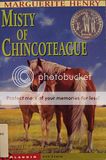
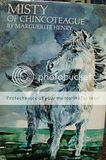
Misty Of Chincoteague (1947) introduced the rest of the nation to Virginia's wild herd, and remains a classic children's book.


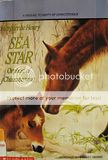
Marguerite Henry wrote four other books about Misty and Chincoteague Ponies: Sea Star, Orphan Of Chincoteague (1949); Stormy, Misty's Foal (1963), A Pictorial Life Story Of Misty (1976), and Misty's Twilight (1992).


Other books about that most famous of herds are:Hundred Acre Welcome by Ronald Rood (1967)and Charming Ponies: A Pony Named Patches (aka Patches) and A Pony In Need by Lois Szymanski (2008)


Hundred Acre Welcome, about naturalist Rood's adventures bringing a Chincoteague pony home to his Vermont farm, is due to be reprinted this summer from Blue Mustang Press, which also publishes Kendy Allen's The Ponies Of Chincoteague series: Misty's Heart Of The Storm, Misty's Black Mist And The Christmas Parade, Chincoteague Cowboy, The Story Of A Chincoteague Pony Named Misty III, and Ember's Story: The Misty Miracle Pony.


There are several picture books, including one by a very nice illustrator, Susan Jeffers - My Chincoteague Pony (2008); also Once A Pony Time by Lynne Lockhart (1992).


And a romance novel!

One Of A Kind by Jo Calloway (1983)


The wild herds of the Carolinas

A children's book reviewed here last year, Stephen W. Meader's Wild Pony Island. Outer Banks horses are also featured in the WWII-era children's adventure tale Taffy Of Torpedo Junction by Nell Wise Wechter (1957) which is now available from the University of North Carolina Press and the 2006 book Pale As The Moon by Donna Campbell Smith.


Sable Island

Pit Pony by Joyce Barkhouse (1990) and Dixie Dobie: A Sable Island Pony by Margaret S. Johnson and Helen Losing Johnson (1945) both feature Sable Island ponies. Pit Pony, which was made into a television series, will be released by Formac in a new edition on August 20, 2010.


Links


North Carolina - the Banker Horse

Wikipedia


Cumberland Island, Georgia

Tribe Equus

Gateway to the Golden Isles

Equitrekking


Chincoteague and Assateague

National Park Service website

The Misty of Chincoteague Foundation


Breed Organizations

The Marsh Tacky

Chincoteague Pony Association


Sunday, April 5, 2009

Mon Mome Wins Grand National

A longshot wins the English classic. As I have no relevant reviews ready, here's a list of Grand National stories, fiction and non-fiction. My heart's always belonged, a little bit, to the first American horse to win the race, Man O'War's short (15.2) chestnut colt Battleship. Another American winner was Jay Trump, a flat racing reject who went on to win the Maryland Hunt Cup three times, and the Grand National in 1965. He was buried at the Kentucky Horse Park, at the finish line of the steeplechase course.

Fiction
National Velvet by Enid Bagnold
Free Rein by K.M. Peyton
Pilot, The Chaser by H.M. Peel

Nonfiction
The Sport Of Queens: The Autobiography of Dick Francis by Dick Francis
The Grand National: A History Of The Aintree Spectacular by Stewart Peters
An Aintree Dynasty: The Tophams And Their Grand National by John Pinfold
The Grand National: Aintree's Official Illustrated History by Reg Green
From Aintree To York: Racing Around Britain by Stephen Cartmell
Jenny Pitman: The Autobiography by Jenny Pitman
Twenty Gallant Horses by C.W. Anderson (includes Battleship, winner of the 1938 race)

Films
National Velvet
Champions
Grand National Night

Other
National Velvet television series
National Velvet Boardgame (based on series)


Links
Times Online
The Grand National
Aintree Racecourse
Youtube of the 2009 Race
Youtube of the 1965 Race
National Museum of Racing and Hall of Fame - Battleship
Thoroughbred Heritage - Battleship