I had to include a tribute to the place where my love of books really took off as a child. Nothing breeds a book glutton like being able to indulge, and second-hand stores are the only way a person of reasonable means - or their child - can afford to indulge like that. I wallowed in books as a child, happy only with a pile of reading material. It's still the way I prefer to read - several at a time, drifting between books whose spines are cracked mercilessly, page numbers committed to memory.
My most recent thrift shop purchase was on Sunday, at a charity thrift shop in a typically New Jersey location - by the side of an industrial highway flanked on one side by the outskirts of a ragged little city and on the other by horse farms. I walked in, spotted a slew of horse magazines and spent the next hour groveling happily in the shelves. I emerged with a stack of The Blood-Horse from 2009, a few Practical Horsemen from 2001, and Hemi: A Mule by Barbara Brenner (1973), which I'd never heard of and which is adorable.
It's funny, but even though thrift shops are the ultimate recycling method, outside of vintage clothing, shopping at them has never quite caught on even with the more crunchy people; thrift shops are still mostly for and about new immigrants and poor people. But what's better than people rehoming used but useful objects, saving money and landfill space?
Extraneous vintage comment
I grew up wearing hand-me-downs, and I really prefer new clothes, no matter how cute vintage is. I do appreciate a nice book about vintage, though, and recently came across a memoir Alligators, Old Mink & New Money which is very enjoyable. And I did find a flawless silk skirt for $6 at a Goodwill last month. Used or no, silk has a home with me.
Find a local thrift shop
Goodwill Industries
Habitat For Humanity ReStores
Saint Vincent de Paul Society
Salvation Army Thrift Shops
Also, hospitals, children's homes and churches often have thrift shops attached.
Tuesday, August 17, 2010


Thursday, August 12, 2010
Odds 'n Ends
Jim's eyes stuck out as much as those of the Sawhorse, and he stared at the creature with his ears erect and his long head drawn back until it rested against his arched neck.
In this comical position the two horses circled slowly around each other for a while, each being unable to realize what the singular thing might be which it now beheld for the first time. Then Jim exclaimed:
"For goodness sake, what sort of a being are you?"
"I'm a Sawhorse," replied the other.
Anyone using Google today will have noticed the Wizard Of Oz banner, commemorating the film's 71st birthday. Although they certainly do not qualify as horsey books, they do feature some equine characters (some more, some less), as with Jim the cab-horse and the Saw Horse in Dorothy And The Wizard Of Oz.Baum, a prolific author, wrote an entire series of books set in Oz. To be exact, he created an entire series. After his death, the series was continued by Ruth Plumly Thompson. Among her books were The Giant Horse Of Oz (1928) and The Wishing Horse Of Oz (1935). The giant horse was a typically strange Oz creation, an immense wooden horse brought to life, but the wishing horse is an actual (if magical) animal.
The World Equestrian Games in Kentucky will feature not only country singers like Blake Shelton but opera star Denyce Graves. I may have to take back my harsh words.
And finally, a clip of a Ringling Bros. Circus horse act, as a prelude to an upcoming review of a memoir by one of the circus's veterinarians. This clip isn't the clearest, but there's something about that bold rush into the spotlit ring which just sums up the appeal of animals in the circus.
Monday, August 9, 2010
Paint The Wind (2007)
I'm having some technical difficulties with my computer, which has quite reasonably refused to deal with my digital photo addiction until I give it more memory. So this review goes on sans cover image, which grieves me, but you can see the cover here.
Paint The Wind
Pam Munoz Ryan, il. Sterling Hundley (cover)
2007, Scholastic Press
"I have a grandfather and he lives with his brother and sister... but they're actually hillbillies with no education and they live like pigs in an uncivilized land. Oh, and they don't appreciate culture and are extremely crass and unsavory."
Maya, a squelched child, has lived most of her living memory with her father's mother in Pasadena. Her grandmother's grief and bitterness over losing her son early has led to the negative impression she's conveyed to Maya. When she dies, Maya is shipped off to Wyoming to live with her mother's long-forgotten family, the Limners.
She slowly turned in a circle and looked up at an endless and cavernous sky. There was far more heaven above her than there was earth below, and the horizon seemed worlds away. Without a white wall to define her boundaries, how would she ever know when she disappeared from someone's view?
Maya's learned to be silent and cunning under the autocratic rule of her grandmother; she flinches from the hearty, emotional welcome of the Limners, and lies fluidly to manipulate her circumstances. When she's sent off to a camp to spend time with her aunt Vi and spoiled cousin Payton, she employs her usual sly tactics to strike back after Payton throws a firecracker at her. Her tactics indirectly causes a horse to be hurt, and drives a wedge between Maya and Vi.
Slowly, things improve as Maya learns to ride and enjoy it, and learns about Artemisia, the mare her mother loved who was stolen away by a wild stallion. When Maya sees the chance to recapture the mare, she seizes it - and becomes involved in a natural disaster that could kill her.
The title is a fanciful expression of the allure of the wild horses and, no doubt, their threatened existence in reality. The title, cover art and comments about 'ghost horses' hint at a fantastic element which does not exist; the book therefore flirts with but never truly grasps hold at the supernatural. It is firmly in place, in love with Wyoming, and its heroine. The character of Maya is well done, but the supporting cast is under served and the relationships seem rushed. The initial segments set in Pasadena establish Maya strongly, but weaken and shorten the vital Wyoming sections.
Horse-wise, I have my reservations. The author is at pains to provide horsey details, and there is a great deal of horse information, including some convincing (if awfully quick) scenes of Maya learning to ride. But it doesn't feel as natural as the rest of the book. According to her website, Munoz Ryan hadn't been into horses until she began writing this book. She fell in love with riding, and her lesson horse Smokey is featured on her website.
Overall, I think it's a very high-quality work of children's fiction, but a not overly impressive horse book. And I actually don't mind. Maya is a subtle, interesting character, and her story is entirely sufficient.
Horses
Artemisia - brown and white pinto mare
Klee -
Wyeth - Artemisia's 2-year-old colt
Sargent - Palomino stallion
Russell - bay ranch gelding
Catlin - bay ranch gelding
Homer - bay ranch gelding
Audubon - dun ranch gelding
Seltzer - blue roan ranch gelding
Wilson - sorrel ranch gelding
Georgia - wild mare
Mary - 2-year-old wild palomino mare
Remington - black wild stallion with white blaze and stockings
Golly - dog
Links
Author website
Scholastic interview
McBookWords - the artists who inspired the horse names above
Illustrator Sterling Hundley's website
Other horse books
Riding Freedom
Paint The Wind
Pam Munoz Ryan, il. Sterling Hundley (cover)
2007, Scholastic Press
"I have a grandfather and he lives with his brother and sister... but they're actually hillbillies with no education and they live like pigs in an uncivilized land. Oh, and they don't appreciate culture and are extremely crass and unsavory."
Maya, a squelched child, has lived most of her living memory with her father's mother in Pasadena. Her grandmother's grief and bitterness over losing her son early has led to the negative impression she's conveyed to Maya. When she dies, Maya is shipped off to Wyoming to live with her mother's long-forgotten family, the Limners.
She slowly turned in a circle and looked up at an endless and cavernous sky. There was far more heaven above her than there was earth below, and the horizon seemed worlds away. Without a white wall to define her boundaries, how would she ever know when she disappeared from someone's view?
Maya's learned to be silent and cunning under the autocratic rule of her grandmother; she flinches from the hearty, emotional welcome of the Limners, and lies fluidly to manipulate her circumstances. When she's sent off to a camp to spend time with her aunt Vi and spoiled cousin Payton, she employs her usual sly tactics to strike back after Payton throws a firecracker at her. Her tactics indirectly causes a horse to be hurt, and drives a wedge between Maya and Vi.
Slowly, things improve as Maya learns to ride and enjoy it, and learns about Artemisia, the mare her mother loved who was stolen away by a wild stallion. When Maya sees the chance to recapture the mare, she seizes it - and becomes involved in a natural disaster that could kill her.
The title is a fanciful expression of the allure of the wild horses and, no doubt, their threatened existence in reality. The title, cover art and comments about 'ghost horses' hint at a fantastic element which does not exist; the book therefore flirts with but never truly grasps hold at the supernatural. It is firmly in place, in love with Wyoming, and its heroine. The character of Maya is well done, but the supporting cast is under served and the relationships seem rushed. The initial segments set in Pasadena establish Maya strongly, but weaken and shorten the vital Wyoming sections.
Horse-wise, I have my reservations. The author is at pains to provide horsey details, and there is a great deal of horse information, including some convincing (if awfully quick) scenes of Maya learning to ride. But it doesn't feel as natural as the rest of the book. According to her website, Munoz Ryan hadn't been into horses until she began writing this book. She fell in love with riding, and her lesson horse Smokey is featured on her website.
Overall, I think it's a very high-quality work of children's fiction, but a not overly impressive horse book. And I actually don't mind. Maya is a subtle, interesting character, and her story is entirely sufficient.
Horses
Artemisia - brown and white pinto mare
Klee -
Wyeth - Artemisia's 2-year-old colt
Sargent - Palomino stallion
Russell - bay ranch gelding
Catlin - bay ranch gelding
Homer - bay ranch gelding
Audubon - dun ranch gelding
Seltzer - blue roan ranch gelding
Wilson - sorrel ranch gelding
Georgia - wild mare
Mary - 2-year-old wild palomino mare
Remington - black wild stallion with white blaze and stockings
Golly - dog
Links
Author website
Scholastic interview
McBookWords - the artists who inspired the horse names above
Illustrator Sterling Hundley's website
Other horse books
Riding Freedom
Tuesday, July 27, 2010
Jersey Shore, Barrier Islands and Pony Penning
In case you've been living peacefully under a rock where the name Snookie means nothing , Jersey Shore is a reality show from MTV which follows a pack of trashy kids in their early twenties on their adventures in a shore town in New Jersey. Last year, Italian-Americans were displeased by the characters' endless use of the word 'guido' to proudly describe themselves and others as low-life, crass, obnoxious morons endlessly preoccupied by shiny things, not least themselves. This year, the story is how the wildly popular show is presenting New Jersey residents to the rest of the country, and Americans to the rest of the world. Leading to the currently high-profile governor of the state being jovially asked about the show's impact on his state's reputation.
The gist of Christie's reply:
"It takes a bunch of New Yorkers, drops them at the Jersey shore and tries to make America feel like this is New Jersey."
I promise this is horse-related.

The gist of Christie's reply:
"It takes a bunch of New Yorkers, drops them at the Jersey shore and tries to make America feel like this is New Jersey."
I promise this is horse-related.
But Christie's right. The New Jersey shore is beautiful. Even Seaside Heights. Like most beaches on the East Coast, it is on a barrier island. Barrier islands are long, flat strips of land lying just off the coast - their openness and general lack of trees or hills makes for an unlimited landscape that meets the endless vista of the ocean and act as a respite from the urban Northeast corridor.
Barrier islands occur naturally, though the exact process seesm to be debated among geologists, and they help protect the mainland from the current and the weather. Although most are very close to
Which creates the phenomenon of the barrier island horses. Chincoteague, whose Pony Penning Day is this week, is the most famous, but there are herds of feral ponies and horses on barrier islands from
As with the mustang herds out west, barrier island horses have often run afoul of the government agencies charged with overseeing the public lands they typically inhabit. The National Park Service's priority is with the wildlife and the fairly fragile ecosystem of these islands, and argue that the well-being of the feral horses can come at the expense of both. Proponents for the horses say they can co-exist. The annual roundup at Chincoteague and Assateague are now a way to curb the population, as well as raise money.
And further north,
But enough of that. What about books? Well, the first one is obvious.
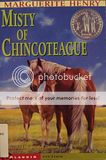
Chincoteague/Assateague
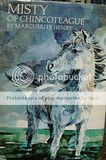
Marguerite Henry wrote four other books about Misty and Chincoteague Ponies: Sea Star, Orphan Of Chincoteague (1949); Stormy, Misty's Foal (1963), A Pictorial Life Story Of Misty (1976), and Misty's Twilight (1992).

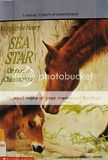
Other books about that most famous of herds are:Hundred
Hundred Acre Welcome, about naturalist Rood's adventures bringing a Chincoteague pony home to his Vermont farm, is due to be reprinted this summer from Blue Mustang Press, which also publishes Kendy Allen's The Ponies Of Chincoteague series: Misty's Heart Of The Storm, Misty's Black Mist And The Christmas Parade, Chincoteague Cowboy, The Story Of A Chincoteague Pony Named Misty III, and Ember's Story: The Misty Miracle Pony.
There are several picture books, including one by a very nice illustrator, Susan Jeffers - My Chincoteague Pony (2008); also Once A Pony Time by Lynne Lockhart (1992).
And a romance novel!
One Of A Kind by Jo Calloway (1983)

The wild herds of the Carolinas
A children's book reviewed here last year, Stephen W. Meader's Wild Pony
Pit Pony by Joyce Barkhouse (1990) and Dixie Dobie: A Sable Island Pony by Margaret S. Johnson and Helen Losing Johnson (1945) both feature
Chincoteague and Assateague
Breed Organizations
Thursday, July 22, 2010
The American Girl Book Of Horse Stories (1946)

The American Girl Book Of Horse Stories
selected by the editors of American Girl magazine, il. Sam Savitt
1946, Girl Scouts of the
shown: 1971 Scholastic edition
I ask you, what would you do if you woke up to find yourself in a perfectly strange room, with a horse staring in the window at you, with daisies in its mouth?
Palomino Cupid by Frances Priddy
An older collection of short stories which lean toward the romantic teen angle. It was compiled by the editors of American Girl, a magazine published by the Girl Scouts Of America during much of the twentieth century.
Some of the stories stand out - the language of "Sundance" and the humor of "Palomino Cupid" in particular - but most are simply adequate romance stories with an equine slant. I remember this book fondly, but I have to admit the overall writing quality isn't high. The collection does manage to cover most of the most common horsey tropes - flashy palominos, wild black stallions, yearningly horseless girls, and the battle between being an equestrian and being a girl - at the same time it covers so many teen romance points, from rich boy/poor girl to practical girl/dreamy boy. A nice read, but the stories don't quite live up to the usual good Savitt illustrations.
Short stories
"Danger Rides The
"Beautiful And Free" by Carolyn St. Clair King
"Fiesta Parade" by Eleanor Hoffmann
"A Touch Of Arab" by Vivian Breck
"Sundance" by June Hall Mills
"Palomino Cupid" by Frances Priddy
"Two For The Show" by Ellsworth Newcomb
"A Horse In Her Future" by Margaret Burrage
"Ana Paula And The Golden Horse" by Marian Garthwaite
"Tall As The Stars" by Janet Lambert
"Danger Rides The
In Revolutionary America, young Lavinia (who prefers to be called Vinnie) is faithfully caring for her brother's young horse, Robin, when the British arrive in search of mounts. Vinnie, desperate to save Robin, pushes the chestnut jumper into the parlor, just as her persnickety aunt Hortense opens the front door to a charming English lieutenant.
Robin's hoofs beat a drumming tattoo on the frozen turf of the meadow. Faster, faster! Vinnie leaned forward, gathering the reins on his neck. "Up, boy!" she cried. The big chestnut cleared the high rail fence superbly, with hardly a break in his stride.
"Beautiful And Free" by Carolyn St. Clair King
15-year-old Gil Bronson, son of a broke rancher, enters a race to catch a wild stallion, hoping to win the reward money to finance his further education. But the violence and intelligence of the horse dubbed the Black Prince makes him hesitate.
Leaping hastily to his feet, Gil gazed upward, and there above him on the rim saw the wide, red nostrils and gleaming eyes of the cornered Prince.
"Fiesta Parade" by Eleanor Hoffmann
Julie is a tomboy who lives for her horse, Topaz, and the wild scenery of her southern
Julie needed every minute of these last three days for grooming her beautiful Topaz and rubbing up the silver conchas on his saddle so that in the whole long fiesta parade of five hundred horses, no animal would glitter like her dazzling young palomino.
"A Touch Of Arab" by Vivian Breck
14-year-old Meggie Mallory and her father are on their annual camping trip in the Sierra Nevada mountains with her horse Cirque - "a Western stock horse with just a touch of Arab" - when he announces she's too insular and he's going to sell Cirque to force her to make friends. In the time remaining, she befriends absent-minded older teen
"Come on, Cirque," I whispered, wishing my bare heels were spurs. In a moment, the current was swirling around his knees. He planted his forefeet on the bottom and refused to budge.
"Sundance" by June Hall Mills
Lissa, heartbroken, watches her beloved horse being loaded roughly into a trailer; her family has sold their bust sheep ranch and is moving to town. The big operation that's bought the place is owned by the father of a childhood friend, Ted, who Lissa is now all too aware of being wealthy and assured.
Fifteen, freckled and wind-blown, she had known contentment. Riding Sundance, the world was hers. Hers the bitter taste of alkali dust and the harsh glitter of the sun in a parched land; a fleeting glimpse of a wildcat, green eyes elequent with hate; the lonely, stirring cry of coyotes; the blessed smell of rain, foretelling the brief glory of rose and ivory cactus blooming in careless rapture; the pungent tang of pine needles, chewed in contemplation; and the sweet, sad cooing of mourning doves.

"Palomino Cupid" by Frances Priddy
A smart teenager discovers that the way to a standoffish boy's heart lies through his adored horse, Golden Boy. But other girls have already tried that, and boy and horse can all too easily see through the usual ploys.
"Two For The Show" by Ellsworth Newcomb
Millie wants to show her horse, the aged former Army
"Don't look now," she said loudly, "but that's an exhibitor's tag Millie's wearing along with those priceless dungarees. Friends, I do believe she's entered that Army nag of hers in the junior-miss class. We'd better watch our steps."
"A Horse In Her Future" by Margaret Burrage
15-year-old Darlene is poor but hopeful about someday getting her own horse instead of just working around the local riding academy. Her usual annoyance at wealthy, bratty Michele turns to sympathy when she realizes the other girl's also lonely amidst the horsey crowd at the barn.
Darlene Manners leaned one shoulder against the wide doors of Barn One and watched wistfully as Hank Cenno, riding master of the 7-Hills Riding Academy, led his pupils on another ride.
"Ana Paula And The Golden Horse" by Marian Garthwaite
In early
The animal's golden coat was shining in the sun, his silvery mane and tail blowing in the wind. He was tossing his head, stepping high with pride of breeding. This was an Ysabella - a true palomino - the favorite horse of the dons.
"Tall As The Stars" by Janet Lambert
Army brats Judy and Cynthia are sisters, but while Judy's a forthright tomboy, Cynthia's a cunning flirt. When it comes to the big horse show on their Army post home, Cynthia manages to talk her sister into swapping her well-trained horse, Jack Snipe, for Cynthia's neglected Charlemagne.
Judy knew how clear the notes of reveillle sounded, floating across the early morning air; with what precision the soldiers drilled on the parade ground, marching proudly under the watchful folds of Old Glory. She loved the sunset gun that stopped the girls and boys on bicycles, the roller skaters, the people in their cars, and held them at attention while the great flag slid slowly down into waiting arms. She loved it all, especially the peaceful sound of taps proclaiming that all was well.

Authors
Margaret Leighton
Leighton wrote at least 17 books, mostly juvenile bios and children's adventures, but only one was horse-related. Comanche Of The Seventh (1957) - the story of the horse who survived Little Big Horn. She also wrote two other books centering on Custer: a juvenile bio of the man himself The Story Of General Custer, and a juvenile biography of his wife Bride Of Glory: The Story Of Elizabeth Bacon Custer.
Carolyn St. Clair King
King apparently wrote romances under the name Sally Lockhart.
Eleanor Hoffmann
I couldn't find anything reliable about her.
Vivian Breck was a psuedonym for Vivian Gurney Breckenfeld (1895-1992). She seems to have written mostly adventure and romance novels for teens. Titles include Maggie (1954), High Trail (1955), and White Water (1958); Hoofbeats On The Trail (1950) appears to be her sole horse book.
June Hall Mills
I couldn't find anything reliable about her.
Frances Priddy
She seems to have written two horse books, The Grand Rogue (1958) and Barbie (1960).
Ellsworth Newcomb (1909-1971)
Newcomb was married to another writer, Hugh Kenny, who wrote science articles. They lived in
Margaret Burrage
I couldn't find anything reliable about her.
Marian Garthwaite
Prolific writer who wrote historical fiction for children and teens. Books include: Coarse Gold Gulch (1956), The Locked Crowns (1963), The Twelth Night Santons (1965), Shaken Days (1952), Bright Particular Star, Holdup On Bootjack Hill (1967), Tomas And The Red-Headed Angel (1950), The Mystery Of Skull Cap Island, You Just Never Know (1955), Mario,
Janet Lambert
An
Links
Denver Library collection - Carolyn St. Clair King
Open Library on Frances Priddy
Jane Badger Books on Frances PriddyJanet Lambert at Jane Badger Books
School Girl Shamus on Janet LambertJanet Lambert at The Malt Shop
Janet Lambert at Image Cascade
Girl Scouts of
Boy Scouts of
Related Note
There is a very similar horse anthology, The Boys' Life Book Of Horse Stories. The contents differ, but it uses Savitt as an illustrator and the covers are virtual twins. It was also identical to this book in that it was put out by the Boy Scouts of America, from their magazine, Boys' Life.
Its ten stories include: Wild Bronc by Kerry Wood, Tale of Two Horses by B J Chute, The Black Outlaw by Stephen Payne, Wild Horse Roundup by Glenn Balch, Ride the Rough String by D.S. Halacy, Jr., The Curb Bit by Carl Henry Rathjen, The Mudhen, V S by Merritt P. Allen, Horse With Cow Savvy by Joseph Stocker, Sacrifice Spurs by Carl Henry Rathjen, and Boss Of The Cross-O by Stephen Payne.
Subscribe to:
Posts (Atom)

 Posts
Posts

