Showing posts with label Nonfiction. Show all posts

Saturday, October 9, 2010

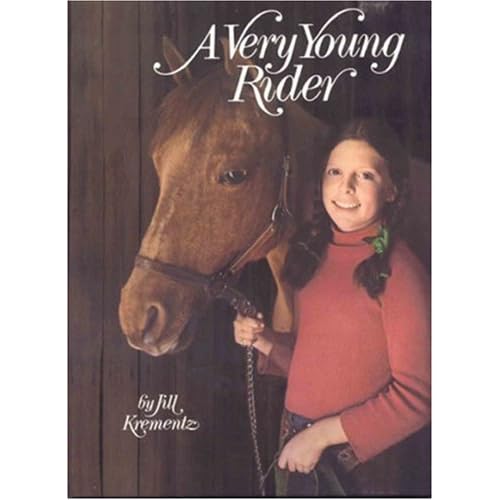
A Very Young Rider (1977)


A Very Young Rider

Jill Krementz, author and photographer

1977, Borzoi Books, Alfred A. Knopf


This oversized photo essay chronicling the experiences of young rider Vivi Malloy is a classic much beloved by women who were horse-obsessed girls in the 1970s and 1980s. Beautiful, evocative black-and-white photos illustrate the everyday chores, training and life of 10-year-old Vivi and her chestnut pony Ready Penny. We also meet Vivi's family, trainer and various friends, and travel to horse shows where Vivi and her older sister Debby are competing. The action is narrated by Vivi, whose voice alternates between matter-of-fact steadiness about chores and riding, and gleeful excitement about special events like a trip to a big horse show.


Vivi is shown participating in Pony Club and doing chores common to all who own horses, but the core of the book is her participation in the world of elite hunter/jumper horse shows. Debby is in training with George Morris, former Olympic rider and de facto god of the hunter/jumper world, and Vivi's trainer is his assistant. Vivi and her sister show at Devon, Lake Placid, Harrisburg, Washington D.C., and Madison Square Garden - the cream of the horse show crop.


Plenty of women remember this book fondly; it's a very beautiful book and that alone made it attractive to a whole range of kids, from those who had Vivi-like aspirations of going to the big show to those who just yearned for their own pony. I was one of the latter and I found the whole show aspect alien; not negative but unimportant. It was the day-to-day routine of her and the pony I found so appealing, as well as the obvious bond between Vivi and Penny.


If you were/are into showing, though, it was catnip. The horse show sequences are a who's who of that era's show world: Gordon Wright, Frank Chapot, George Morris, Michael Matz, Buddy Brown, Kathy Kusner, Bert de Nemethy, Rodney Jenkins.


It is dated now beyond the bell-bottoms and the harness-free velvet helmets:


I love cotton candy but it's so fattening. When I get older like Debby, I'll have to go on a diet. Debby's always on a diet or else George gets after her. Once she went on a pure liquid diet and almost fainted in school. I have to watch my weight now a little bit. You don't want to get too heavy for your pony. There's nothing uglier than a fat rider on a horse.


Granted, this is a book of its time and that time was blithely unaware of the dangers of encouraging teenage and adolescent girls to obsess over calories to the point of fainting. Still, that last little tidbit is telling. Morris is nearly as famous for his outspoken personality as for his riding and coaching, and he has long had a very strong opinion on weight. As times changed and possibly as he mellowed, he's toned it down, but the stories that circulate about his youthful comments are hair-raising. Worth seeking out, by comparison, is his monthly jumping critique at Practical Horseman magazine, as well as the happy parody of same at Hillbilly Farms.


About the author

Jill Krementz (1940-___)

A New Jersey native, she was married to Kurt Vonnegut.


Other Books

A Very Young Dancer

A Very Young Skater

A Very Young Circus Flyer

A Very Young Actress

A Very Young Gardener

A Very Young Gymnast

A Very Young Musician

A Very Young Skier

How It Feels To Be Adopted

How It Feels When A Parent Dies

How It Feels To Fight For Your Life

How It Feels When Parents Divorce

How It Feels To Live With A Physical Disability

A Visit To Washington D.C.

Holly's Farm Animals

Jamie Goes On An Airplane

Lily Goes To The Playground

Zachary Goes To The Zoo

Sweet Pea: A Black Girl Growing Up In The Rural South

Black Writers

The Jewish Writer

The Writers Image

Writers Unbound


Links - the author

New York Social Diary - a bit about Krementz appears halfway down the page

Wikipedia


Links - about the book

A May 1995 article about the book and its subjects at The Chronicle Of The Horse magazine. Extremely interesting, as it discovers what happened to everyone, ponies included; a pony nerd dream.

George Morris at Practical Horseman

Parody of GM's column at Hillbilly Farms

National Horse Show - originally at Madison Square Garden

The Devon Horse Show

Derby Hill, Buddy Brown's h/j training stable in California

Rodney Jenkins at The Showjumping Hall of Fame

Michael Matz at The Showjumping Hall of Fame

George Morris at The Showjumping Hall of Fame

Gordon Wright at The Showjumping Hall of Fame

Frank Chapot at The Showjumping Hall of Fame

Kathy Kusner at The Showjumping Hall of Fame

Bert de Nemethy at The Showjumping Hall of Fame

Sports Illustrated article about Dennis Murphy in the 1974 National Horse Show

Longview Farms, Dennis Murphy's h/j training barn in Alabama

Monday, September 27, 2010

The Problem Horse (nonfiction)


I saw this little book on the shelf at a library, in amidst more typical old books like How To Ride Western (1970's era with copious dusty black and whites of Quarter Horses) and glossy newer books with titles like Buying Your First Horse. Despite the helpful practicality of the other titles, this sort of period piece draws my eye.


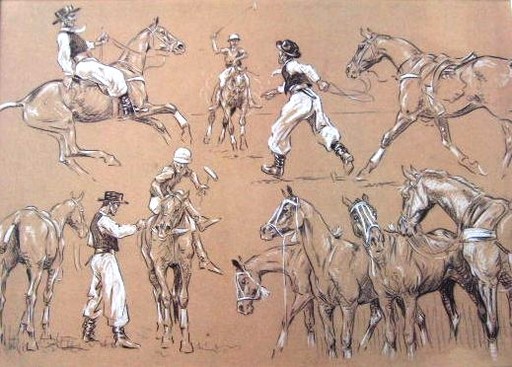
I know this blog is supposed to be fiction, and mostly American, but who could resist these illustrations?


It's smoother, but some of it reminds me of Paul Brown's work. It's that combination of action-striated lines with idealized, slightly vague backgrounds.


Links
Wikipedia on the author

Books by Summerhays
Here's Horse Sense


From Saddle to Fireside

Elements of Riding


Elements of Hunting


Riding For All


Observer's Book of Horses and Ponies


The Problem Horse


It's A Good Life With Horses


Summerhays' Encyclopedia for Horsemen


Our Horses Horses and Ponies


Riding on a Small Income


The Story of the International


The Young Rider's Guide to the Horse World


A Lifetime with Horse


About John Board
1895-1965
A polo player and illustrator.

Books by Board (author)

Horse And Pencil


A Year With Horses (1954)


From Point To Point


Polo


Horses And Horseman

Practical Horsemanship In Show And Field


Books by Board (illustrator only)
Horseback Riding by C.E.G. Hope

Work included in anthologies
The Horseman's Bedside Book (1964)
The Horseman's Year 1958

More examples of Board's art
Polo
Blacklock's Polo Art website

Friday, July 2, 2010

More Than Courage (1960)


More Than Courage: Real Life Stories Of Horses And Dogs And People Who Have Loved Them
Patrick Lawson, il. Earl Sherwan
1960, Whitman Publishing Company


To all the horses and dogs that have been trying to communicate with dumb humans for thousands of years, this book is affectionately dedicated.

This collection of stories about horses and dogs is undoubtedly dated - the references to Native Americans as redskins and the cheerful statement that bloodhounds are not gay but solemn dogs make that clear. But there's a sort of romance to its sweeping vision of the world.

The horse relieved man of the burdens he had always had to pack upon his own back. It enabled him to plow more land and so produce more food. Its greatest gift, however, was mobility. By carrying man swiftly from one place to another, the horse helped him to increase his area of activity and speed up the interchange of knowledge. Take away the horse and history would have to be rewritten.


More to the point, the author does know animals.

As with all animals, horses have a habit of blithely disproving every statement made about them by experts.


The first chapter sets up the entire book. This is to be an examination through examples of the debate between those who attribute all animal behavior to instinct and training, and those who believe animals are capable of intelligent reasoning. It's quickly evident which side the author is on. When I researched Lawson and discovered he was actually Lois Eby, it made sense. Women, like animals, have often been on the wrong side of the experts when it comes to judging intelligence and reasoning power.

The chapters switch off, one concentrating on dogs and the next on horses. Below are the horse chapters.

The Question
The crowd's roar of admiration suddenly changed to a gasp of horror. The horse had whirled to face his fallen rider. He looked to them now like a maddened killer... Then an astounding thing happened. The horse paused beside the man's prone body, sniffed it, and carefully, delicately, stepped over it to trot unconcernedly toward the arena exit.
(rodeo bucker Midnight)

Drumming Hoofs
...the action of cavalry horses and their courage in battle is all the more remarkable. A horse can be taught to ignore gunfire, but how can he continue to have confidence in a master who deliberately leads him into a situation where he is severely wounded.
(military horses including 19th century Indian fighters Prince and Two Bits, General Sherman's horse Sam, General Meade's horse Baldy, and Alexander the Great's horse Bucephalus)

Pegasus Without Wings
Kincsem's approach to the post would have shamed a milk wagon plug. Where the proud thoroughbreds paced and pranced, she plodded. Having arrived at the starting line, she just stood there, tail drooping, head down. In race after race she was left behind, while every track fan in Europe held his breath and chewed his nails. Yet somehow she always managed to win.
(a blind pacer named Sleepy Tom, the jumper Snow Man, the Hungarian racehorse Kinecsem)

Enter - A Star!
Fury is definitely a camera hog. On the set, he keeps edging forward to get close to the camera until he is practically hanging over the human actor's shoulder. One harassed director finally set up a dummy camera. Fury, unaware that there was no film in it, posed before it happily while the real camera shot the scenes with the rest of the cast.
(The Lipizan stars of the film Ben Hur, Roy Roger's Trigger, Gene Autry's Champion, TV stars Fury and California)

About Lawson
Lois Eby grew up in California, where she fell in love with Arabian horses and nature. A writer for film, she also wrote mysteries and novels.

Other books by Patrick Lawson
Star-Crossed Stallion

Star-Crossed Stallion's Big Chance

Patty Lynn: Daughter Of The Rangers


Patty Lynn At The Grand Canyon


"Hard Luck Stallion" - a short story about a boy trying to tame an Arabian stallion named Ajaz. July 1954 edition of the magazine Boys' Life. Basically the Star-Crossed Stallion story.

About the illustrator
(1917-2002)
A native and lifelong Michigan resident, Sherwan specialized in nature and dog pictures, writing and illustrating many books and producing a popular line of canine-themed notepaper.

Books written by Sherwan
Mask, The Door County Coon by Earl Sherwan (1963)
Bruno, The Bear Of Split Rock Island by Earl Sherwan (1966)


Links
"Hard Luck Stallion" (Part I) at Google Books - Sam Savitt illustrations
"Hard Luck Stallion" (Part II) at Google Books
"Hard Luck Stallion" (Part III) at Google Books
"Hard Luck Stallion" (Part IV) at Google Books

Jane Badger Books bio of Lawson
(The comment about the book's physical limitations is spot on - I basically destroyed my copy doing this review. It is now a collection of loose yellow pages within a fragile carcass of covers and spine.)
IMDB on Lawson
Lawson's mystery series
Standard Printing - Earl Sherwan info

Thoroughbred Heritage - Kincsem
Show Jumping Hall of Fame - Snow Man
Greene County, OH - Sleepy Tom
Sam Savitt poster of famous Standardbreds with Sleepy Tom

Other material about featured horses
Dwight Akers wrote a 1939 book about Sleepy Tom.
Sam Savitt wrote a book called Midnight: Champion Bucking Horse about Midnight.
Rutherford George Montgomery wrote a book about Snow Man; there was also a movie and a Breyer model.
Fury, of course, was a TV show based on a book, Albert G. Miller's series. He was also made into a Breyer model.

Tuesday, May 25, 2010

Wild Horse Annie And The Last Of The Mustangs: The Life Of Velma Johnston

David Cruise & Alison Griffiths

2010, Scribner


Velma walked over and peered through a gap in the slats, expecting to find cattle or sheep. Instead, she saw a horrifying tableau of mutilated horses, some barely alive. Her eyes caught sight of a colt, or what was left of him, lying trampled, his bones crushed and coat blood-soaked. A number of horses had bloody stumps instead of legs. Others had sections of their hooves torn off and hides shredded by buckshot. A stallion stood with his head bowed, blood seeping from empty eye sockets. He had been blinded to subdue him. It was only the tight quarters that kept many of the horses upright. A penetrating stench, the combination of blood, urine and feces, rose from the truck while flies swarmed over the brutalized animals, jammed so tightly they couldn't flick the insects away with their tails.


In the spring of 1950, Velma Johnston was a 38-year-old woman permanently crippled up by a childhood attack of polio, but she was a fighter who'd carved out for herself the life she'd always wanted - a husband, a home, and horses. When she noticed blood flowing out of a livestock truck near Reno, Nevada she followed it to the stockyards, intending to let the driver know he had a hurt animal on board. What she found was the intended end of the wild horse in the American West - a bloody, violent death for the mustangs, thousands of dollars in slaughter sales for the chasers, and a more complex victory for the Burea of Land Management (BLM), the government agency that oversees vast swathes of public land in the United States.


The BLM's attitude was that the mustangs were a nuisance at best and a pest at worst, and needed to be eliminated. The authors trace that attitude back to various issues of the late 19th and early 20th centuries; the use of 'free' wild horses as a profitable source of meat to satisfy a growing market for commercial dog food, endless competition and violence over grazing rights, a new industrial market for horsehide in conveyor belts. But ultimately, the policy that the survival of the range and the rancher depended on the extinction of the mustang lay in the post-WWI expansion of ranches, and the heedless use of the range to feed herds. Over-stressed native grasses died; the plants that replaced them were less nourishing and when they also failed to hold the earth together as well, the topsoil began to wear away.

There was no incentive for conservation on the public land. Everyone owned it and nobody owned it. It was the classic dilemma of the commons, where no one takes responsibility for a resource that is free for all, and therefore it is ruined by all. And ruin was exactly the state of the grazing lands in the early 1930's when drought struck.


In 1934, Congress passed the Taylor Grazing Act. From that act came what would eventually be the BLM, and its power over 143 million acres of public land. From the beginning, the big cattlemen had a big voice with the BLM. The agency, under pressure to do something about the depleted grazing lands, blamed the mustangs. And by 1950, the BLM was claiming they'd removed over 100,000 horses from the range. Which is roughly where the middle-aged secretary from a hardscrabble ranch in Nevada stepped in. By the time she died in 1977, she'd gone from an independent operator whose first forays into saving the mustangs was to literally sabotage pens of miserable horses in the middle of the night and release them back into the wild, into a savvy political operator who used direct-mail campaigns and media sympathy to circumnavigate a hostile bureacracy. Her results - and her dogged determination to enforce the laws she got passed - would have been impressive for anyone; for a working-class woman struggling with physical pain, working a full-time job and caring for a sick husband, it was extraordinary.


The authors don't flinch from discussing Johnson's less attractive side. She's quite calculating about her depiction in Marguerite Henry's version of her story, Mustang: Wild Spirit Of The West, and she clashes with other mustang activists over the years. Worse, she essentially steals the work of a rancher named Gus Bundy, whose spectacular photographs of mustangs being chased by airplanes in a 1951 roundup were repeatedly used by Johnston without credit or payment. As the authors point out, she worked for a businessman for most of her adult life and she certainly knew a few things about copyright.


For anyone who read the Henry fictionalization of Johnson's life and work, some of the most interesting sections here are chapters 9 and 10, which focus on the relationship between the writer and her subject. Henry was already famous for her children's horse books when she began the project and Velma grew to like both the personable author and the cachet of being associated with her. Marguerite Henry employed her usual folksy style to make a kinder, cuddlier - and considerably less aggressive - Velma. Her family is made more of a rural sterotype, people who can't string three words together without uttering some pithy bit of down home wisdom. Her husband Charlie is transformed from a loving but wordly roughneck 13 years older than her to a sweet neighbor boy named Charley. Velma's disfigurement is only hinted at, her job is downplayed, and altogether she's made over into a simple, happy young wife who stumbles across a brutal injustice and fights back successfully using right as her shield. The simplification is understandable, but I never found Henry's version as satisfying as her other, equally folksy books. Maybe it was the serious content - there's something about those gruff and lovable poor folk that doesn't quite gell with slaughtered horses and trips to Congress.


The writing style is clear and the research was thorough and honest. Cruise and Griffiths make a big story thorough and enjoyable, and while Wild Horse Annie doesn't have the power or lyricism of a great work of nonfiction, it easily surpasses most of the competition.


Links

Simon & Schuster

Find A Grave

Running Wild (1973) at IMDB (movie based on Velma's life)

Bureau of Land Management Environmental Education Resource

Time Magazine - July 27, 1959 article