In the Laura Ingalls Wilder book Farmer Boy, the horse-loving boy Alonzo goes with his family to the closest town to celebrate Independence Day. His father, a prosperous farmer, raises Morgans, which Alonzo will prize above all horses for the rest of his life.
Father's shining horses were hitched to the shining, red-wheeled buggy, and they all drove away in the cool sunshine. All the country had a holiday air. Nobody was working in the fields, and along the road the people in their Sunday clothes were driving to town.Father's swift horse passed them all.
For most of our history, fast harness horses have been an American obsession, a back door to pride and racing in communities that often officially frowned on both. And each year on the Fourth of July the sport of harness racing goes to its home in Goshen, New York for a celebration of newly inducted Hall Of Fame people and horses. Horse races, particularly harness races, were a traditional part of the Independence Day celebration for years. Several uniquely American breeds of horse originated primarily as harness horses, from the extinct Narragansett Pacer which was supposedly the breed that carrie Paul Revere on his most famous journey, to the modern Standardbred.
Books (juvenile fiction) The Phantom Filly by George Agnew Chamberlain (1945) Born To Trot by Marguerite Henry (1951) The Black Stallion's Blood Bay Colt by Walter Farley (1951) The Good Luck Colt by Genevieve Torrey Eames (1953) The Black Stallion's Sulky Colt by Walter Farley (1954) Lord Buff And The Silver Star by George Agnew Chamberlain (1955) Bellfarm Star: The Story Of A Pacer by Col. S.P. Meek (1955) Old Sam, Thoroughbred Trotter by Don Alonzo Taylor (1955) The Horse Comes First by Mary Calhoun (1974) The Gallant Gray Trotter by John T. Foster (1974) illustrated by Sam Savitt Rebel's Choice by Patricia Harrison Easton (1989) Summer's Chance by Patricia Harrison Easton To Race A Dream by Deborah Savage (1994) Small Gains by K.M. Peyton (2004)
More Than Courage: Real Life Stories Of Horses And Dogs And People Who Have Loved Them
Patrick Lawson, il. Earl Sherwan
1960, Whitman Publishing Company
To all the horses and dogs that have been trying to communicate with dumb humans for thousands of years, this book is affectionately dedicated. This collection of stories about horses and dogs is undoubtedly dated - the references to Native Americans as redskins and the cheerful statement that bloodhounds are not gay but solemn dogs make that clear. But there's a sort of romance to its sweeping vision of the world.
The horse relieved man of the burdens he had always had to pack upon his own back. It enabled him to plow more land and so produce more food. Its greatest gift, however, was mobility. By carrying man swiftly from one place to another, the horse helped him to increase his area of activity and speed up the interchange of knowledge. Take away the horse and history would have to be rewritten.
More to the point, the author does know animals.
As with all animals, horses have a habit of blithely disproving every statement made about them by experts. The first chapter sets up the entire book. This is to be an examination through examples of the debate between those who attribute all animal behavior to instinct and training, and those who believe animals are capable of intelligent reasoning. It's quickly evident which side the author is on. When I researched Lawson and discovered he was actually Lois Eby, it made sense. Women, like animals, have often been on the wrong side of the experts when it comes to judging intelligence and reasoning power.
The chapters switch off, one concentrating on dogs and the next on horses. Below are the horse chapters.
The Question The crowd's roar of admiration suddenly changed to a gasp of horror. The horse had whirled to face his fallen rider. He looked to them now like a maddened killer... Then an astounding thing happened. The horse paused beside the man's prone body, sniffed it, and carefully, delicately, stepped over it to trot unconcernedly toward the arena exit. (rodeo bucker Midnight)
Drumming Hoofs ...the action of cavalry horses and their courage in battle is all the more remarkable. A horse can be taught to ignore gunfire, but how can he continue to have confidence in a master who deliberately leads him into a situation where he is severely wounded. (military horses including 19th century Indian fighters Prince and Two Bits, General Sherman's horse Sam, General Meade's horse Baldy, and Alexander the Great's horse Bucephalus)
Pegasus Without Wings Kincsem's approach to the post would have shamed a milk wagon plug. Where the proud thoroughbreds paced and pranced, she plodded. Having arrived at the starting line, she just stood there, tail drooping, head down. In race after race she was left behind, while every track fan in Europe held his breath and chewed his nails. Yet somehow she always managed to win. (a blind pacer named Sleepy Tom, the jumper Snow Man, the Hungarian racehorse Kinecsem)
Enter - A Star! Fury is definitely a camera hog. On the set, he keeps edging forward to get close to the camera until he is practically hanging over the human actor's shoulder. One harassed director finally set up a dummy camera. Fury, unaware that there was no film in it, posed before it happily while the real camera shot the scenes with the rest of the cast. (The Lipizan stars of the film Ben Hur, Roy Roger's Trigger, Gene Autry's Champion, TV stars Fury and California)
About Lawson
Lois Eby grew up in California, where she fell in love with Arabian horses and nature. A writer for film, she also wrote mysteries and novels.
Other books by Patrick Lawson Star-Crossed Stallion
Star-Crossed Stallion's Big Chance Patty Lynn: Daughter Of The Rangers Patty Lynn At The Grand Canyon
"Hard Luck Stallion" - a short story about a boy trying to tame an Arabian stallion named Ajaz. July 1954 edition of the magazine Boys' Life. Basically the Star-Crossed Stallion story.
About the illustrator (1917-2002)
A native and lifelong Michigan resident, Sherwan specialized in nature and dog pictures, writing and illustrating many books and producing a popular line of canine-themed notepaper.
Books written by Sherwan Mask, The Door County Coon by Earl Sherwan (1963)
Bruno, The Bear Of Split Rock Island by Earl Sherwan (1966)
Other material about featured horses Dwight Akers wrote a 1939 book about Sleepy Tom.
Sam Savitt wrote a book called Midnight: Champion Bucking Horse about Midnight.
Rutherford George Montgomery wrote a book about Snow Man; there was also a movie and a Breyer model.
Fury, of course, was a TV show based on a book, Albert G. Miller's series. He was also made into a Breyer model.
This book is mostly about what happened after we got to our homestead in the Dakota Territory, but I guess I better begin before that and tell how we got Old Sam and how he came to be crippled.
John Scott is 7 when a stranger passes by his family's Mississippi farm with a beautiful grey trotter tied to the back of his buggy. The horse slips on a bridge and breaks a leg, but when the stranger asks John's father to loan him a gun to put the horse out of his misery, the Scott children beg him to reconsider. The owner, already heartbroken, agrees to give them the horse, who makes a partial recovery.He has a crooked and shortened leg and a limp, but he does get back the use of the limb.And for a crippled horse he's surprisingly useful, able to pull a plow and a buggy.
Three years later, in 1882, the family moves west, settling on 480 acres on the Dakota prairies, in a region then known as "The Great American Desert."The family is relatively well-off, and with 12 other horses to do the grueling work of breaking a prairie into cultivated land, the grey is left to his own devices.
But Sam was not idle.He was always on the go - all over the place.He didn't follow us like a dog any more than we did him, for there were times when he would attract my attention with a short whinny and I would see him standing in the distance, his head up and his ears cocked forward, looking in my direction.That could mean only one thing, and I would call to Lee, "Hey, Lee, come on!Sam is waiting for us."He was just one of us, and that is how we treated him.
The cousins John and Lee have various adventures, usually involving Sam.
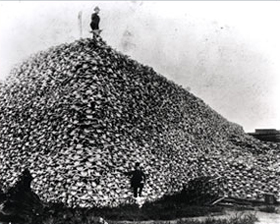
In the morning, a strange world was spread out before us.The day before, the prairie had been the light faded color of last-year's grass.But in the morning, as far as the eye could reach, the prairie was black as coal.No - not all of it was black.There was something else that attracted immediate attention.Standing out in sharp contrast to the black background were the white bones of thousands of buffaloes, a tragic reminder of the ruthless slaughter that had cleared the plains of these majestic animals in just a few years.
After a prairie fire, John and Lee get lost collecting buffalo bones (used back East as fertilizer and in sugar refineries) and Sam is called upon to find the route home.The horse does, reliable as a watch.But it's two years after the move that Sam moves back into his old world of racing.The boys, challenged by their family's conviction that their victory in an impromptu race was just a kind gesture by their adult opponents, secretly enter Sam in the Fourth of July trotting race against a field of adults driving sound, young horses, including the favorite, Chestnut Prince.When they get to the starting line, however, a combination of distaste for the spectacle of a crippled horse drawing a bulky farm wagon and an uneasy awareness that said crippled horse has a certain reputation for speediness provokes the other drivers to demands Old Sam's withdrawal.The cousins sadly comply, but when the starter shouts "Go!" Sam takes off.
This is far more a pioneer book than a horse book. The horse plays a recurring role and ties the stories together, but this was originally a series of stories the author told his children with the intention of recapturing his pioneer youth, and it's clear that his interest was largely in that experience. This in itself is an interesting story, of course, but it's a little disconcerting when you go in expecting a horsey book. The stories Taylor told his kids became a book when his grown daughter, Hazel Hohanshelt became a teacher and repeated the stories.Inspired by their interest, she began editing them into a book.
Note:
The book was reissued in 2008 under the title Old Sam: Dakota Trotter by Bethlehem Books.
About Don Alonzo Taylor
1872-?
Married Jennie Anderson in 1901, and moved to Oakes, North Dakota.They had four children.In 1924, they moved to California, settling in Alpine, near San Diego.
About Hazel Taylor
1905-2004
Married Forrest Hohanshelt and taught school in Alpine, California.
The bidding was slow.And the prices were low.Too low for a filly from a fine family of trotters.Too low for a filly with a broad chest, a proud head and wide-set eyes.But it was just as the sparrows had said; no one wanted a horse, especially a trotter, that had "trouble" written on her sweat-stained coat.
A Standardbred racehorse named Scarlett is so tense she has trouble winning until new owners provide her with stable buddies.Rufus Jones the Third, a rooster, and Merabel, a goat, give the nervous filly the companionship that she's lacked, and ultimately help her win.
Cute beginner reader book with a pleasant plot and nice illustrations by Gail Owen.
About the Author
According to Penny Pollock's website, she was born Penelope Lee Morrow in Ohio in 1935, but spent much of her youth in the Philadelphia suburb of Swarthmore. She married Stewart Pollock in 1956, and had four children.
About the Illustrator
Gail Owens was born in Detroit in 1939. She began her career at advertising agencies in New York, later illustrating magazine articles and books. She did the illustrations for A Horse For XYZ by Louise Moeri.
 Roast them marshmallows.


 Posts
Posts