In Wild About Horses, a nonfiction book which examines the history of humans with horses, author Lawrence Scanlan devotes one chapter to ponies, and attempts to understand the phrase "pony character," as used by the breeders and owners he interviews. While he maintains he never quite got the whole idea, he came up with a good starting point:
I imagine that a pony with pony character has a strong sense of his own self.
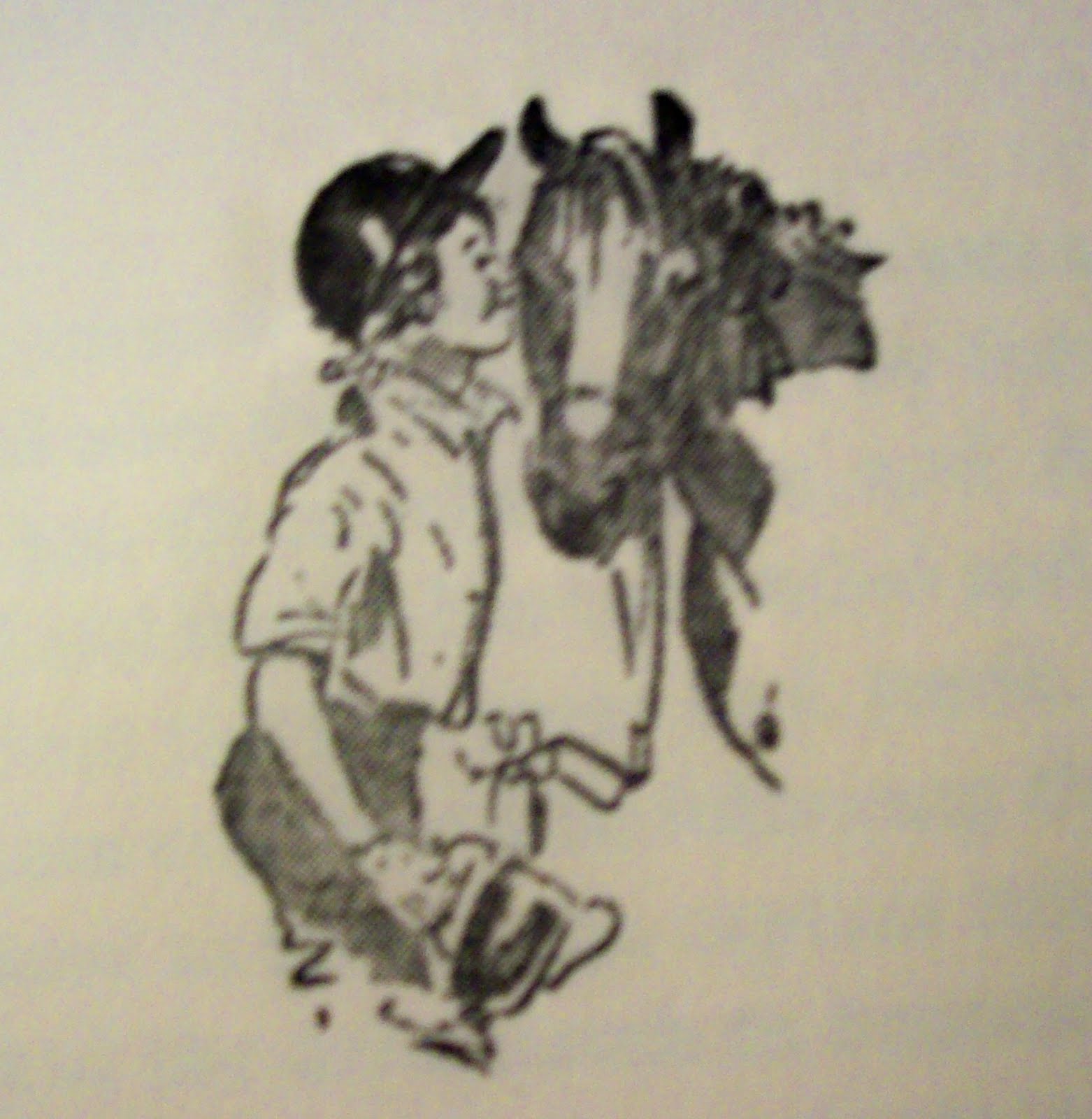
Although Wesley Dennis did many pictures of horses, there's something infinitely appealing about his ponies. Their shaggy roundness offsets their ever-alert ears, making a portrait of scruffy, everyday realism that is so much more inviting than the elegant perfection of, say, Anderson's flawlessly long-striding Thoroughbreds or Savitt's athletic hunters. And maybe that is another part of pony character; reality. You never hear about a pony having "the look of eagles;" there are no legends of wild ponies leaping to their deaths to escape the mustangers. They're not fanciful or legendary. And Dennis's ponies look like realists.
Your Pony Book by Hermann Wiederhold
Dennis's collaborations with Marguerite Henry were the most famous, but he illustrated a slew of other pony books where that 'pony character' came through the illustrations.
The Ginger Horse by Maureen Daly
A Cavalcade of Horses, ed. Florence K. Peterson and Irene Smith
"We are a family, even though we are different types of animals. No one is going to separate us!"
The little chestnut pony Puddleby is happy living with his friends Smooch (a pot-bellied pig) and Cedric (an old white goose), and the three conspire to remain together whenever potential buyers come to look at Puddleby. This changes when Miss Thea arrives. She can literally understand their speech, and quickly discerns that the three want to stay together. They go to live on Windham Hill Farm, where Puddleby makes equine friends for the first time. But living with show ponies makes the tiny Puddleby worry about his own talents. Too small to be ridden by any but the smallest of children, a poor jumper, with plain movement, he's clearly not meant for show ring success. What he doesn't realize is that Miss Thea has had a plan for him all along - she wants to use him as a therapy pony.
This is a sweet book with charming illustrations and an attractive, fairy-tale quality. The first half, which focuses on the animals, flows better than the second half, which introduces elements requiring more explanation. At this point, the story and the language become somewhat more labored as the author struggles to introduce new characters and convey the nature of the training Puddleby undergoes.
The book seems to have originated with a real-life therapy pony, and was written to raise money for a charity, Going Miles For Smiles, which appears to focus on the use of therapy ponies.
Note I was somewhat confused by the Miles For Smiles purpose. I'm aware of hippotherapy, in which horseback riding is used as a physical and mental therapy for the disabled, and I've heard of dogs, rabbits, cats, etc., being taken into nursing homes and hospitals and the like as 'therapy animals' to comfort and engage people who are sick, elderly, etc. But using a small pony for the latter purpose seems overly complicated, considering the practicalities of taking even small equines inside a building. The website says:
Going Miles for Smiles aims to seek out and discover people of all ages who are losing hope in life, for those who are sad and despondent, or for those who simply have had some bad luck in life and need a lift upwards. GMFS is committed to ensuring that attention is given, entertainment is provided, and above all love is poured forth for those whose dreams are dashed or who have a sad view of the world and their life at hand.
Googling around, I found an article which says that Wilcox traces her inspiration back to a prayer where she decided to do something special to 'give back' if a very sick child she knew recovered. The child recovered, and she later recalled the promise after buying Puddleby.
Animals Puddleby - small chestnut pony Smooch - beige pot-bellied pig Cedric - white goose Adam - grey show pony Jupiter - chestnut show pony DieZel - black show horse
This is not a pony book or a horse book, but a children's mystery with a horsey element in that the child sleuths ride ponies to investigate the curious doings in their mountainside home town. Sorry about the image of the cover - in my defense, it was an early attempt to photograph a book (which is surprisingly difficult considering they just sit there) and the copy I was using was not in great shape.
Mystery of The Dancing Skeleton Christine Noble Govan and Emmy West, il. Joseph Papin 1962, Sterling Publishing
Several years ago when the older children in the families had begun to want bicycles, Dr. Randall, Jimmy's father, and one of his close friends, Mr. Cordell, had agreed that ponies were not only more fun but safer.
Where were these men when I was a child? At any rate, this is the fairly thin link between this conventional mystery story and horse stories. A group of friends on Lookout Mountain agree to help run the pony ride concession at the town's annual Halloween fair. Something seems shifty about one of the men who is in charge of the ponies, and before you can say "Lookout club" there's a mystery afoot.
The fair has two purposes - to raise money for the local schools and to keep the kids out of trouble on Halloween. How very dull. The town's never very clearly drawn - it's obviously up a mountain and a fairly rough sort of place, but then the kid's parents are almost all well-off. There's a big livestock auction/yard right near the business district, which implies the town is tiny. And there is the fat, excitable, lazy and derided fat kid.
The writing is pedestrian and the mystery isn't very involving. Characters are vague, as is the sense of place, despite the unique location. The illustrations are probably the most interesting part of the book, dark, vivid and far too complex to fit this story.
Horses and other animals Silky - pony Horatious - old horse Snowflake's King - white pony Windsong - black pony Trouble - Irish Setter Bunny - Beagle
About the authors Christine Noble Govan (1898-1985) and Emmy West were a mother-daughter writing team. Govan's husband and children were all writers; daughter Mary Govan Steele wrote under the name Wilson Gage, and her book Journey Outside was a Newberry Honor Book. Govan also wrote mysteries as Mary Allerton and J. N. Darby.
About the illustrator Joseph Papin also illustrated Dorothy Potter Benedict's Bandoleer and Fabulous.
Other books in the Lookout Club series Mystery At Shingle Rock Mystery At The Mountain Face Mystery At The Shuttered Hotel Mystery At Moccasin Bend Mystery At The Indian Hide-Out Mystery At The Deserted Mill Mystery Of The Vanishing Stamp Mystery At The Haunted House Mystery At Plum Nelly Mystery At Rock City Mystery At The Snowed-In Cabin
Other books for teens and children Those Plummer Children Five At Ashefield Judy And Chris Narcissus An' de Chillun String And The No-Tail Cat Sweet 'Possum Valley Mr. Hermit Miser And The Neighborly Pumpkin The Pink Maple House The Surprising Summer The Super-Duper Car Tilly's Strange Secret Rachel Jackson, Tennessee Girl Willow Landing The Delectable Mountain Number 5 Hackberry Street The Curious Clubhouse Return To Hackberry Street Phinney's Fine Summer Mr. Alexander And The Witch The Trash Pile Treasure Danger Downriver
Short Stories "Miss Winters And The Wind" in anthologies Stories Not For The Nervous and Timeless Stories For Today And Tomorrow.
Doodlebug Irene Brady, author and illustrator 1977, Houghton Mifflin Company
Jennifer loved horses. All horses, really. But the horse she wanted was a Beautiful Black Stallion with Flowing Mane and Tail (she always thought of it in capital letters). And it just had to be more beautiful than Myra Bank's chestnut mare, Daisy!
Jennifer Dickens, who seems to be around 10, is glumly sitting on the rail at a livestock auction, contemplating the paltry $14.52 she's saved for her dream horse, when she impulsively buys a starving black pony to save him from a kill buyer. She takes him home, nurtures him back to health and tries to ride him. Ouch. Her new pony's showy trot is agony to ride. None of this is helped by her bete noir Myra, a teen neighbor whose position as a horse owner has soured relations by placing Jennifer in the position of begging for rides and Myra in the position of benevolent dictatorship.
Her parents, who breed goats, are gently supportive but suggest that Doodlebug can earn his keep by pulling a cart. Jennifer isn't thrilled at the idea of owning a carthorse, but agrees to try. The now healthy and strangely sleek pony almost trains himself and before long, they are smoothly delivering goat milk to her parents' customers. With a little poisonous input from Myra, of course:
"That little Doodlebug is the sweetest workhorse I ever saw!"
Strangers appear, revelations occur, Myra suffers a put-down that seems entirely overdone, and Jennifer fears she'll lose her little black horse for good.
A very short (35 pages) book with plenty of very nice illustrations and a brisk, pleasing story. A few minor quibbles - it seems odd that the goat breeder parents don't geld the pony (goat people, from what I've gleaned as a lifelong addict of books on how to raise livestock, are not squeamish about this) and Jennifer can hardly be a good rider just from cadging a few rides on someone else's horse - but overall a good story. I do wonder about the conflicted heroine dramas, though, where the little girl protagonist basically doesn't want the horse/pony she ends up with, and it takes the threat of losing the creature for her to realize - oh, I love Mr. Bones! It just seems a little - bratty?
Odds and Ends The story itself is fairly timeless, but in the illustrations those parents are the very picture of 1970s anti-style.
The name Doodlebug is cute but unusual enough I went googling and came up with: * A nickname for a German bomb used in WWII (which I remembered from far too many British kid books involving the Blitz) * A nickname for a 1930's Ford car that was turned into a tractor during WWII steel shortages * a nickname for small, self-propelled train cars * a nickname for pill bugs
The common denominator seems to be smallness.
Books by Irene Brady (horse) America's Horses & Ponies Doodlebug
Books written by others, illustrated by Irene Brady (horse) Cloud Horse by Jill Pinkwater
"I've never heard of anything like it.That black horse couldn't have impressed me more if he'd won a blue ribbon at MadisonSquareGarden.Standing out there like that - waiting for you to cut him free."He shook his head, scratching the back of his neck."Beats me!The most remarkable thing was the confidence he had in you.Somehow he knew you would help him if he waited.And you didn't let him down!"
Vicki Jordan has just freed her father's black Thoroughbred, Pat, who she adores, from a tangle of barbed wire.The horse emerges unscathed because he doesn't panic, and Vicki's father is bemused by the bond between his daughter and his horse.Smilingly, he promises her that pony she's always dreamed of.And Vicki is silent.What she wants is Pat.The former racehorse had come to Random Farm sick and used up, and the girl had devoted herself to his care.But Dan Jordan can't see past his daughter's youth, and she seems destined to yearn for the big horse.Sucking it up, she decides to focus on the promised pony.When her very first buying expedition turns up a starving, neglected creature far too small for her, Vicki impulsively buys him to save him.
The mane was ragged and dragged along the ground.Vicki bent over and lifted it to reveal the shrunken neck and bony shoulder.She let her hand wander aimlessly over the scrawny hide stretched tight as a drum around the emaciated body.It was sticky, gray with grime, swarming with flies.She crouched down to examine the hairy legs and long, cracked hooves that badly needed trimming.There was an ache in her throat as her eyes took in the flanks that sucked inward and the hipbones that pushed outward, threatening to break through the skin.She stepped back and walked behind the pony, noticed the tent-shaped rump and the concave sides and the tail - long, greasy, knotted with burs.
Even half-dead, Jesse (as he comes to be called) is a firecracker.Vicki's macho older brother assumes, wrongly, that one football hero can easily handle one skin-and-bones Shetland; it won't be the first time someone underestimates the little animal.Exasperated by Jesse's trouble-making, escape artist ways, Vicki considers selling him.What stops her is Pat.The black horse, long the only equine on the farm, has fallen in love with Jesse.Surely, though, Pat will get over it if Vicki sells Jesse to a good home and buys herself a pony she can actually ride?
Although Savitt was primarily an artist, his writing is evocative and concise.The action sequences are clear and intelligent:
That first buck put Vicki astride his neck, the second pointed her wildly thrashing legs to the heavens.She came to earth on her backside as Jesse and the other ponies shot past in a shower of dust and flying hunks of dirt.
The plot moves unhurriedly but without excess, and the language is rich.
He would love a hot mash tonight - bran and oats and molasses and hot water made the most delicious-smelling concoction.She tasted it occasionally as a mother samples a dish before giving it to her baby.
Best of all, the ending is perfectly handled, with dual happy endings for humans and equines.
Drawbacks include a fair amount of sexism- Vicki idolizes her daddy and her older brother, a female neighbor has hysterics after a riding accident, forcing Mr. Jordan to sternly calm her - and a slight lack of character development in humans other than Vicki. There is a certain smugness to the adult male characters - they're pleasant men, but blithely obnoxious, as with Dan Jordan's belief that no one but him can ride Pat.
Animals
Giant Pat, aka Pat - black Thoroughbred gelding with a star
Jesse James the Outlaw, aka Jesse - black and white Shetland pony gelding
Rocky - Irish Setter
Teddy - goat
About the Author/Illustrator
1917-2000
Savitt wrote and illustrated dozens of books, and his portraits of horses and dogs are well-known. He lived on a farm in North Salem, New York, was married and had two children. He spent several years as the official artist for the U.S. Equestrian team. Several of his drawings are held at the National Sporting Library.
Peanuts The Pony Arensa Sondergaard and Mary Maud Reed 1941, D.C. Heath & Co.
True, there is no actual review here. But I feel this is a) fitting as the book itself contains no actual words, and b) beside the point, as the illustrations are very lovely.
One of a series for beginner readers called Our Animal Story Books.
Other books by Arensa Sondergaard The Horse With The Flying Mane My First Geography of the Panama Canal The Little Fir Tree Fun For Fidelia The Snow Man Fuzzy Tail A History of the United States for Young People Biddy And The Ducks Maybelle The Donkey A Day With Old Joe They Went Exploring
Other books illustrated by Doris and Marion Henderson Penny The Puppy Little White Rabbit A Real Kitten Why? Dick and Dot: A Primer Singing Hearts Zeke the Raccoon Trim The Christmas Tree Maeterlinck's The Children's Bluebird My Dog Laddie
The icicles have finally begun melting and falling off the eaves with great exciting cracks. The birds, which appear to share my dislike of the continuing presence of 16" of snow everywhere, responded with great excitement to my offering of moldy bread this morning. The breakfast crowd included the cursed robins, who have quite obviously quit the whole tiresome migration business and elected to remain here year-round as taunting non-harbingers of spring. All of which is to explain the posting of a review about a holiday-themed book which would on the face of it seem to be a bit late in the day. It has snow on the cover, it's going in.
The Christmas Pony
Sylvia Green, il. Sharon Scotland
2001, Scholastic
"Of course you can't have a pony for Christmas, Laura.We couldn't possibly afford one."Dad looked determined.
Poor old Dad.You know his determination is that of the doomed pony parent.The elderly neighbor who owns Mr. Crumbs is moving to Australia, and her aging palomino pony is scheduled to be retired to a horse rescue far away.But Laura doesn't want to lose her equine pal, and has rallied her brother Ben and her friends Emily and Sanjay to raise money to persuade her parents to adopt the pony instead.
Mr. Crumbs tossed his head, shaking his long mane, and blew gently through his nostrils.Laura couldn't imagine life without him.
The writing is very simple, the plot lacks urgency, but children's fundraising efforts are believable and sensible. The book seems aimed at children who are just past the beginner reader stage.
Horses
Mr. Crumbs - 18-year-old palomino pony
Other books
The Best Christmas Ever (cat)
The Best Dog In The World
Christmas Quackers (duck)
The Soft-Hearted Sheepdog
The Lonely Chick
The Christmas Wish (donkey)
Etc.
Green is English, and the while the book is non-specific about exactly where it's taking place, there is a vague, indescribable Englishness about it. This sort of thing always fascinates me about English-language books, even those which aren't deliberately trying to be generic enough to appeal to a wider audience. It's usually possible to realize from the writing alone that a writer is American or English or Canadian or Australian*. The slang, the choice of character names and, of course, the biases and prejudices we all enjoy. My favorite is the phrase "North America," which is almost always a big red (maple leafed) flag that you're currently enjoying the writing of a Canadian author.
* Yes, I realize I left out the Irish and the Scots, but it's a lot harder, generally, to make that distinction so I've lumped them in with the English.
In a nod to last month's Caldecott awards to the artists of the best American picture book of 2009, a look at a picture book from Susan Jeffers, 1974 Caldecott Honor winner for Three Jovial Huntsmen.*
My Pony
Susan Jeffers, author and illustrator
2003, Hyperion Books for Children
I want a pony.I want a pony more than anything else in the world.
A little girl wants a pony; her parents tell her they can't get her one, and she dreams every night of a dapple gray mare who comes and takes her for magical rides.
A very simple picture book showing the power of the horseless child's passionate desire, constant fantasy and total belief.Gorgeous.
* Jeffers' Caldecott-winning book was based on an old children's rhyme and not, as I first thought, on an even older song which was the source of another book titled Three Jovial Huntsmen. This second, older book was illustrated by Randolph Caldecott, the 19th century English illustrator of children's books who the American awards are named after. The huntsmen in Caldecott's version are foxhunters; the ones in Jeffers' are portly guys on foot.
Pony Farm Paul Brown, writer and illustrator 1948, Charles Scribner's & Sons
Lucky kids Bud and Lynn live next door to a farm that raises Shetland ponies, and owner Mrs. Marian allows them to come over and ride and watch the foals.One foal in particular, the spectacularly marked Half 'n Half.The colt of head broodmare Snowflake, he has many adventures which are fully illustrated, from chasing frogs to running with other foals to getting into trouble.
Slight story, charming drawings.
Ponies Mickey "Matchless Michael of the Titans" - black stallion Snowflake - white broodmare (32" at the withers) Half 'n Half - black and white foal (18" at the withers, 27lbs) The Pest - orphaned filly Molly - foster mother to The Pest Fuss Budget - cautious broodmare Brenda - Fuss Budget's foal
Other Animals Joshua - black cat Deuce - Dalmation Trey - Dalmation Charlotte - donkey Prince Charming - goat
Other Books by Author (writing; Brown illustrated far more) Crazy Quilt: Circus Pony Mick And Mac War Paint Sparkie And Puff Ball PonySchool Draw Horses
About the Author 1893-1958 Subject of a biography Paul Brown: Master of Equine Art by M.L. Biscotti.
Wednesday, February 18, 2009
Martin Rides The Moor Vian Smith, il. Ray Houlihan 1964, Doubleday
11-year-old Martin Manningham has gone deaf, possibly as a result of a swimming accident.His father, a Dartmoor farmer, tries to restore his resentful and withdrawn son to an active and happy boy by buying him a pony.Martin sees through the ploy and intends to ignore the pony - but circumstances in the form of a blizzard force him to take an interest and soon he's in love with the little mare he names Tuppence.The interest in Tuppence brings Martin out of his shell and he befriends a neighbor, Jane, whose father is a pony dealer and whose mounts are never really safe from being sold.Together they ride the moor, go on a fox hunt, enter gymkhanas, etc.All is well until Tuppence goes missing, following a wild stallion onto the moor.
Well-written, with a nice blend of adventures, horse talk and the advancing plot of Martin's acceptance of his disability.
Rough illustrations are sometimes effective, sometimes weak.
Themes Abuse Rescue My Parents Aren't So Bad, After All
Other Books Tall And Proud (aka King Sam) Green Heart Genesis Down Pride Of The Moor Minstrel Boy Come Down The Mountain The Horses Of Petrock The Lord Mayor's Boy Parade Of Horses Point To Point
Friday, February 13, 2009
WildPonyIsland Stephen Meader, il. Charles Beck 1959, Harcourt Brace
14-year-old Rick Landon is a sullen, fatherless kid growing up in an impoverished Brooklyn neighborhood.When he gets into a gang, his mother decides to move the little family south to her home town, the North Carolinaisland of Ocracoke.There Rick is transformed from listless punk to clean-cut boy by the influences of small town life, the country's only equine Boy Scout troop and a stern male relative.And, of course, his love for the palomino stallion called Dandelion.
The writing is disappointing.The indirect voice and awkward sentence construction saps interesting and eventful scenes of most of their life:
Rick hung on.One spine-jarring jolt followed another, but he managed to land back in the saddle each time.Then the young horse sunfished, twisting in the air till his rider was dizzy.Both feet had lost the stirrups now, and Rick knew his luck was about to run out.
Rick's desire to be a cowboy is fulfilled on Ocracoke, where apparently only boys ride the wild ponies.His mother, raised on the island, meets Dandelion one day; her lordly young son tells her to feed the horse an apple, and "She held the fruit out timidly."The breaking methods come across as brutal and ridiculous today - did the kid really have to climb on a young horse the very first time he'd ever been in a corral?The villain of the piece, Windy Jenkins, is the only unfriendly kid on the island and he's quickly dispatched.
Very nearly not a horse book at all.Most of the ponies aren't given names, and are treated much like taxis - if you want to ride, you go look for a herd and grab a pony; when you're done riding you just slap them on the flank and off they go back to the herd.The ponies wander everywhere through the village and feed themselves, are released after every ride to go run wild again.I have my doubts about how they release the stallion Dandelion after both his breaking and his triumph as herd stallion - surely it would be hard to recapture him to ride?Rick is portrayed as being fond of and considerate of his pony, sheltering him from a hurricane (oddly, though, he rides around looking for Dandelion and once he finds him, abandons the pony he was initially riding to the weather without a second thought) and the like.But the horse sections are flat and unconvincing.
Charles Beck's illustrations, warm and simple and realistic, are the best part of the book.
Horses Sweet Sue - chestnut mare, roping horse in NYC rodeo Satan's Child - blue roan bronco in NYC rodeo Old Horny - brown bronco at NYC rodeo Dandelion - palomino stallion
Themes Horse Show Missing Daddy I'm a TROUBLED teen (but not like, you know, on heroin) Born Free! Free as the wind blows....
Other books by Author Red Horse Hill Cedar's Boy
About the Author Meader was born in 1892 and died in 1977. He had strong ties in the Philadelphia area, graduating from Haverford College and working at Philly companies Curtis Publishing Company, Holmes Press, and ad agency N.W. Ayer and Son. Several of his fifty-plus books for children were set in southern New Jersey, where he eventually settled down in first Moorestown and then Cape May Courthouse, and in the Pocono Mountains of eastern Pennsylvania.
Source: The Stephen Meader Collection at the de Grummond Children's Literature Collection at The University of Southern Mississippi, and the bio section on the Southern Skies website.
Note As of 2006, Meader's books were being reissued under the name Southern Skies
Monday, January 19, 2009
Can I Get There By Candlelight? Jean Slaughter Doty, il. Ted Lewin 1980, Macmillan
Gail Simmons rides her Welsh pony, Candlelight, through a rusted gate behind her new home, and discovers meets a lonely rich girl who wears old-fashioned clothing and is shocked to see another girl riding astride.Despite the evidence that something is odd, Gail decides to take the friendship as it comes.And Hilary is a good friend, for a while.
This weak but haunting story presents two horse-crazy girls from very different worlds sharing a summer delighting in one beautiful pony mare.As in "Summer Pony,"the approach of fall brings about a crisis.All of Jean Slaughter Doty's horse books have an element of melancholy, but here it becomes the book.The sense of something bad always about to happen is the main attraction, and despite the crucial presence of the pony and rider in the plot, it fails to ever become a pony book, which makes it very different from most of Doty's work.
I call it weak not because it fails to be a pony book, but because despite the effectiveness of the mood created, it has numerous serious flaws.A short book, it still can't quite support the slim plot, and after a long, fitful buildup with entirely unnecessary forays into Gail's family life, it ends abruptly.The main characters are fuzzy; Hilary is a slightly spoiled rich girl who doesn't want to go to boarding school and does something very nearly evil, and Gail is a rather dull middle-class girl who's a little worried about going to a new school in the fall too.The mare is initially given quite a personality, but fades into the background until the very end of the book.
Practical Information Some glorious information about sidesaddle and carriage horses, which are two things not commonly seen in pony books.
Horses and other animals Candlelight (Candy), a Welsh pony mare Nanette, a small white dog
Social Aspect There is considerable emphasis placed on the wealthy Hilary's lifestyle, with the mansion serving as a summer home, the Mama and Papa in Europe, the governess and maids and coachmen.It is, of course, a more interesting story for a child, the 'princess' lifestyle of a bygone age, but reading the book as an adult, I'm a bit more critical of the modern princess lifestyle of Gail, whose family is living temporarily in a small house while their big new house is built for them, who owns a purebred Welsh pony, whose mother apparently does nothing more onerous than shop for the new house...
Setting Vaguely Northeastern, author was from Connecticut
Illustrations Ted Lewin's illustrations are black and white drawings, even on the cover (unusual) and actually do fit the rather modern attitude of the book and the era, unmistakably belonging to the 1970's brand of realistic flatness.
Other Books Doty's other horse novels include Summer Pony, Winter Pony, The Monday Horses, and The Crumb. She also wrote a dog book, Gabriel, and several nonfiction works on horses as Jean Slaughter (Pony Care, Horsemanship For Beginners, and Horses Round The World)
Themes Bourgie Parents Where's that footman? GHOSTS!!! MagicGardens Bulldozers on the Prowl
Poor Badger K.M. Peyton, il. Mary Lonsdale 1990, Doubleday
Ros Palfrey is horse-crazy but lacks opportunity until she spots a handsome pinto pony grazing in a park near her home.Completely around the bend about the pony but suspicious of his careless owners, she makes it her mission in life to look after Mountfitchet Meteor Light or, as she calls him, Badger.But despite her efforts, his owners' sloppy care slowly turns to neglect, and as winter approaches, Ros begins to believe that Badger will die of hunger and cold.So she hatches a plan...
Going home from school, the path led out of Safeway's parking lot and across a wide stretch of rough ground toward the railroad.It was spring, and the ground was greening happily, bright with dandelions and -
Ros stopped in her tracks and Leo, trailing, walked into the back of her.
"What?"
"Look!"Her voice quivered with glory."Look!"It squeaked, out of control.
Leo looked.Usually the field was empty, except perhaps for an old man walking his dog, but today a pony was grazing in it, held by a chain fastened to a tether.
I am so jealous.I always wanted to find a pony tied out in a field by my town's supermarket.All I ever found was a turtle.Damn those English towns with their wacky commons and lack of proper zoning regulations, making Americans drool with envy.
A crisp and energetic book with a dreamy sidekick who comes into his own, a brave heroine, a realistic villain and an adorable pony.I would quibble that the heroine's parents are rather spineless when the pony's owner calls up to complain about their daughter's behavior.Her father's caution about it being chancey to draw the RSPCA's attention to the pony's condition seem more about reluctance to get involved than a real concern about the pony or his daughter.And the insistence on realism at the end was more labored than a traditional perfect ending would have been.
Did I mention the adorable pony?The cover makes that quite clear.The interior illustrations are less charming, being rather rough and doing a better job with the human faces than the pony.
Animals Mountfitchet Meteor Light/Badger - black and white pinto pony gelding Ermintrude/Erm - dog
Themes Horse Show Abuse Rescue
Other Books Flambards Fly-By-Night Flambards In Summer The Team
When Ginny Anderson convinces her parents to lease her a pony for the summer, she never expects that her dream horse will be so - real. The first shock is the decrepit Sweetbriar Pony Farm, where her loving but unhorsey parents take her to select a pony. The second is the pony, a skinny pinto mare with mismatched eyes and a mind of her own. The third is the reality of caring for an animal who can die from overeating and fly into a lethal panic over a falling leaf. But as the Andersons learn about stable management and Ginny learns to ride, the summer becomes fun, especially when Ginny makes friends with a neighbor who also rides.
Summer Pony is impressive in its handling of a typical situation - a horsey child with unhorsey parents, and the problems that creates - in a solid, realistic manner that manages to be interesting and involving without resorting to the more spectacular adventures that many horse book rely upon. True, Ginny does conveniently makes friends with a wealthy, horsey neighbor girl whose family has an Irish stableman who is a ready source of information and help. But without a few useful coincidences, the heroes of pony books would be stuck doing what we did as kids - reading library books on the porch while wishing we had ponies.
Information-wise, Summer Pony is one of those that gives the hungry wannabe horse owner good food. Ginny's shown puzzling out how to bridle her new pony, learning the difference between bits, and other fascinating-to-horse-people arcana. Catnip.
Illustrator: There is no separating this book from its illustrator. Sam Savitt's cover alone makes the book sing. The interior drawings are as alluring. Savitt's warm, safe style suits this book perfectly, and it is a beautiful marriage. The most recent edition unfortunately replaced Savitt's realistic cover painting with a cartoonish watercolor.
Other books by the author: Winter Pony (sequel) The Crumb The Monday Horses Can I Get There By Candlelight? Yesterday’s Horses If Wishes Were Horses The Valley Of The Ponies Dark Horse
 Your Pony Book by Hermann Wiederhold
 The Ginger Horse by Maureen Daly
 A Cavalcade of Horses, ed. Florence K. Peterson and Irene Smith
 Old Bones by Mildred Mastin Pace
 Your Pony Book by Hermann Wiederhold


 Posts
Posts


