Star Rider
Carole Carreck, il. Steve Jones (cover) Peter Wilkes (internal)
1985, Puffin Books
You, the reader, are the heroine of this story. You have ridden horses all your life and have great natural ability as a rider. You have secretarial qualifications, but your one ambition in life is to own a good horse and make a career for yourself riding.
A choose-your-own-adventure style pony book from the UK, this loopy (literally) role-playing game/book kicks off with your purchase of a show pony named Braid. The action quickly expands to include two handsome, mysterious, occasionally smitten men and a lot of ambitious decision-making about the best course of action to bring Braid and you to your full potential.
I really can't resist a book with a horse on the cover. I remember the days of the CYOA books (the 1980s) and I think I liked the American version better. There's something slightly alarming about having a book assert that I (or, as they put it, YOU) am driving Range Rovers through Wales while arguing about bloodsports and exclaiming "Bother!" when passing a woman on a push-bike. And yet, the format is fun. Something I'd almost forgotten until skimming this one just now is that the adventures can end badly. Braid (what a name!) can become too injured to compete. You can become too injured to compete. And in the startlingly brutal final words of several possible storylines, "Your adventure ends here."
Notes
This series, "Starlight Adventures," was designed to appeal to girls (the CYOAs were often horror/mystery series, and typically appealed to boys) and appear not to be related to each other. In other words, this was the only horsey one.
Links
Review of Star Rider
Monday, May 23, 2016
Tuesday, May 3, 2016
The Winter Horse (2014)
Philip Kerr, il. Eva Kolenko (cover)
2014, Alfred A. Knopf, imprint of Random House
(paperback is Ember imprint of RH)
“Oh, the Przewalski’s
are strong, sir. None stronger. And they’re clever, too. Resourceful. Cunning,
even.”
In late 1941, zookeeper Maxim Borisovich Melknik is the only
worker left at the State Steppe Nature Reserve of the Ukraine, or
Askaniya-Nova. The Germans, busy expanding their eastern front, have arrived in
the form of a group of SS led by Captain Grenzmann. Maxim, who recalls the
German founder of Askaniya-Nova with great fondness and is not the most
enthusiastic of Communists, is prepared to give Grenzmann and his men the
benefit of the doubt. Until they start
eating his animals.
The reserve consists of a zoo and a large wildlife preserve;
the crown jewel of this remote Soviet park is the herd of Przewalski
horses. Grenzmann, a restless German,
begins almost immediately to search for a way to eradicate these “inferior”
horses. He’s largely successful, but a breeding pair (Temukin and Borte) escapes
and the increasingly obsessed Nazi launches a hunt for the dangerously fertile
horses.
At the same time, a member of another dangerously inferior
race is hiding out at the reserve.
Kalinka, a Jewish girl who’d barely escaped the mass murder of her
family, is making the reserve one more stop in her endless journey of escape:
“Three uncles, three
aunts, my brothers, my sisters, my grandparents, my great-grandmother, and all
my cousins. Everyone had to gather in the botanical gardens in our city. Which
is where it happened. I mean, where they and all the others were killed. Not
just my family. But every family. At least, every family that was Jewish.
Fifteen or twenty thousand people. I’m not sure.”
Kalinka is charmed by her encounters with the herds of
Przewalski, and horrified when the Germans machine-gun most of them. But that
horror is only the latest in her histories of grief and death, and she almost
immediately has to worry about surviving a Russian winter.
Maxim and his dog, a Borzoi/Russian Wolfhound named Taras,
help Kalinka survive a blizzard, but she can’t stay there. Grenzmann’s passion
to kill those last horses leads him straight to Kalinka, who must run again.
Przewalski horses are, as the book admits, wild. You do not
ride them, you do not halter or pet them. They’re closer to zebras than to
ponies. During the first half of the book, the horses are shown to be smart and
insightful and a little more accepting of handling than you’d expect, which the
humans note and chalk up to their extreme need.
But in the second half of the book, as Kalinka sets out alone into the
snowy landscape with only the horses and Taras for company, the animals become
the drivers of the action and all but speak to one another. Kalinka, dependent
on the horses for warmth at the very least, is briefly the dependent of the
animals.
With jaws bared
viciously, the first wolf – a big male – launched himself like a streak of
snarling gray lightning at the girl, only to be met by a perfectly judged
double kick from Temujin as both the stallion’s rear hooves lashed out in
unison and connected very solidly with the wolf’s body
Despite the hostility of the wolves (historically symbolic
of the Nazis), the worst, most enduring dangers come from humans. For a time, all the humans they encounter are
brutal monsters.
An interesting book, blending realism and a WWII legend
nicely.
About the Author
Kerr is best known for a series of spy thrillers, but has also written other children's books under the name P.B. Kerr.
Links
Kirkus review
Book optioned for animated film
Author website
Website for Askaniya-Nova
Sunday, December 27, 2015
Robin Kane: The Mystery of the Blue Pelican (1966)
Eileen Hill, il. Sylvia Haggander
1966, A Whitman Book, Western Publishing Co.
This is the first book of the series, and at best, it’s just
too simple to be an enjoyable read for an adult. And there are a few too many
mid-century nightmares, from Mexican mamacitas to Irishmen lilting charmingly
about leprechauns. I’m going to be lazy here and refer you to another website for
a nice summation of the book. I quit after the third chapter. In my defense, I
was reading it for this blog and Robin’s reaction to hearing her horse had
vanished is to be sad, finish dinner and go to bed for some bad dreams about
her lost horse. Not very
horse-book-heroine, Robin. Her horse,
Nugget, doesn’t actually appear until near the end, so overall not really a
great example of a pony/horse book.
More complete review
at Lost Classics of Teen Lit, 1939-1989
Series
The Mystery of the Blue Pelican
The Mystery of the Phantom
The Mystery of Glengary Castle
The Candle Shop Mystery
Mystery in the Clouds
The Monster of Wolf Point
Friday, December 25, 2015
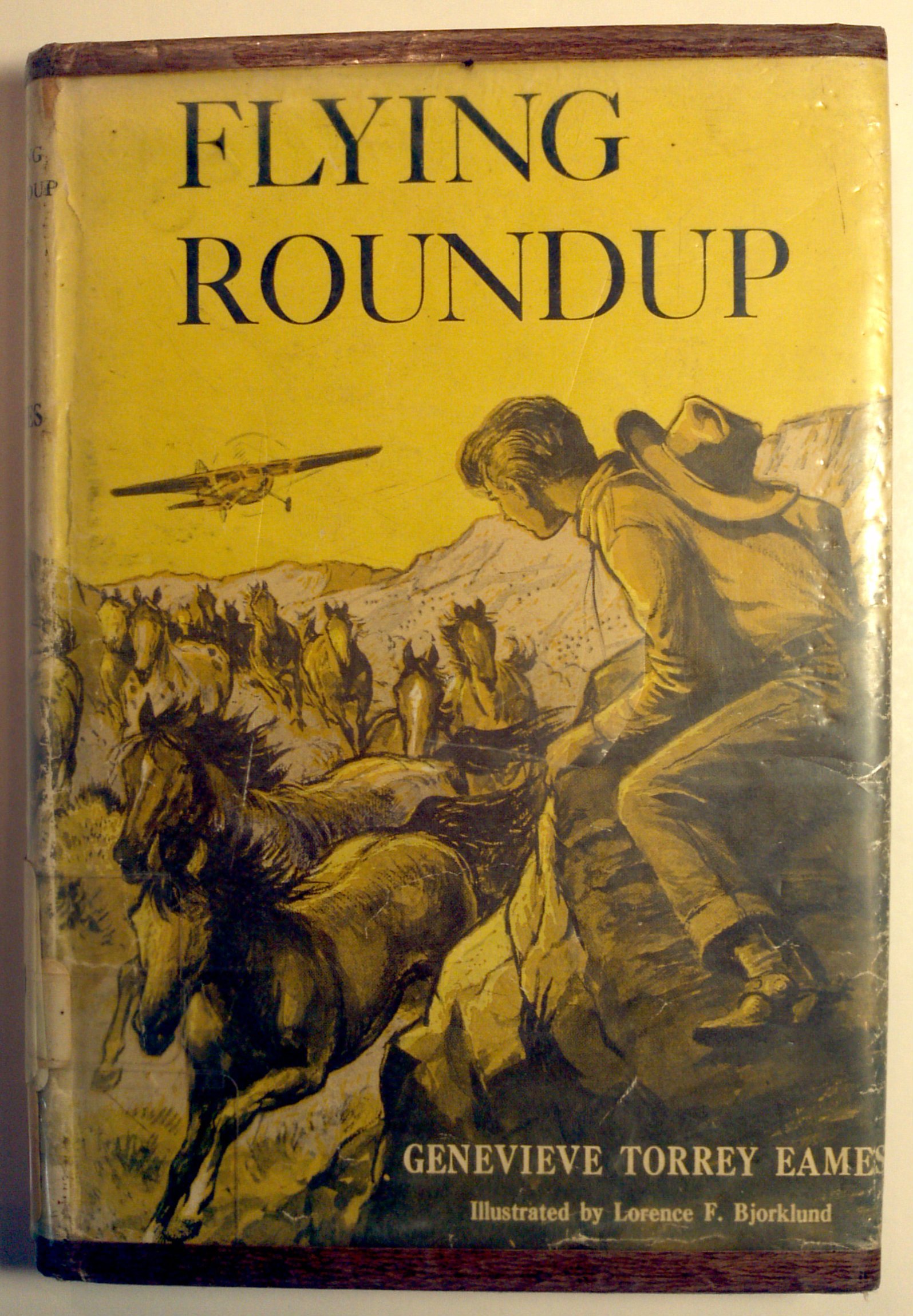
Flying Roundup (1957)
Flying Roundup
Genevieve Torrey Eames, il. Lorence F. Bjorklund
1957, Julian Messner, Inc.
The noise grew louder
and around the base of the mountain came a small band of horses, manes and
tails flying and a cloud of dust swirling about them, kicked up by their
galloping hoofs. Johnny’s heart raced at
the sight. The leaders started into the
valley, halted and swerved away again.
Then, above the hoofbeats, came the roar of a motor and a small yellow
plane swung into sight, following the horses and flying so low it seemed almost
to skim the brush and willows along the stream.
As the horses hesitated it circled out to head them off and then roared
up behind them, sending them in a mad stampede up the valley.
Johnny Shaw is dozing, postponing the end of a camping trip,
when he sees a roundup of wild horses, dominated by an airplane. The scene is brutal – the terrified herd runs
down and crushes a foal, and the cowboys frankly tell Johnny that the wild
horses being driven into a truck are destined for a cannery – but Johnny’s
torn. The pilot is the father of his two
best friends, Dan and Linda Cameron.
Vern is newly home from Korea, and trying to use his Air Force skills to
tide over his new ranch. Johnny
recognizes the family’s genuine need, but when he spots an overlooked band of
wild horses, he heads into the hills to find a way to get them moving before
anyone else spots them.
There are two kinds of children’s books – those where the
villains are the villains, and those where the villains are really just people
you don’t know well enough. This is the
latter. Johnny comes to understand where
Vern’s coming from, and how the money from his flying roundups is intended for
good, and somehow the early scene with the agonized foal is overwritten. It’s not very satisfying.
About the Author
1894-1991
Other books by Eames
(horse)
Pat Rides The Trail
(1946) il. Dan Noonan
A Horse To Remember
(1947) il. Paul Brown
The Good Luck Colt
(1953) il. Paul Brown
Ghost Town Cowboy
(1957) il. Paul Brown
Other books by Eames
(dog)
Handy of the Triple S
(1949) il. Paul Brown
Short Stories
Jarvis Discovers Gold" appears in the anthology Horses,
Horses, Horses: Palominos And Pintos, Polo Ponies And Plow Horses, Morgans And
Mustangs edited by Phyllis Fenner
Someday I’ll Race Him in Young Wings – the Magazine of the
Boys’ and Girls’ Club
Monday, September 7, 2015
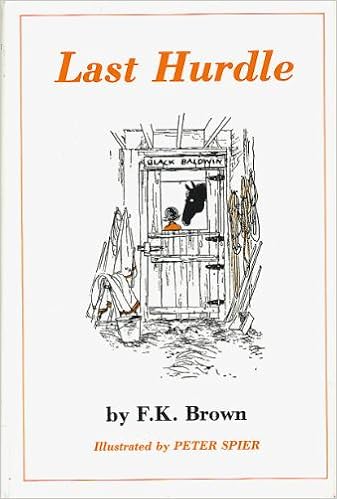
Last Hurdle (1953_
F.K. Brown, il. Peter Spier
1953, Thomas Crowell (not shown)
With a sigh, she
tipped her head back and stared up at the soaring board sides of the barn.
Sunlight slid down through the open half of the stable door to bathe the big
box stalls with light. In her imagination, she saw heads moving among the
shadows behind the barred upper halves of the stalls, and she could almost hear
the soft fluttering of nostrils, the stamp of hoofs.
Katherine Nelson’s family has moved to a falling-down farm,
and although she has never been on or near a horse, she is determined to acquire
one. She’s already stalking the local horse owners, showing up when a nearby
farmer is taking his team in for the day and beguiling a ride:
Half of her mind kept
singing “This is the first time I’ve ever been on a horse! I’m riding a horse –
a horse!” while the other half kept trying to remember all the things she had
read in her horse books: how to grip with the knees, how to hold the reins in
both hands, how to keep the ankles straight, heels down. But she was far too
excited to think very clearly, so she just sat there, smiling happily to
herself and riding.
Kathy and obliging little brother Ned join finances to
liberate an abused, neglected horse from a careless owner, with the
encouragement of hired man Willie. Their
parents, initially amused at their game, realize suddenly that the kids aren’t
just being imaginative, they actually did manage to buy a horse.
“You what?” her mother
shrieked, rising from her chair and almost tipping it over in her haste. “You
did what? What on earth are you talking about?”
Kathy names the black horse with a white face Baldy, and
nurses him back to health. And
naturally, her thoughts turn to further achievement. Now that Baldy’s healthy again, she begins to
jump him and plots to enter him in a local show. The show, held at a country club over the
Memorial Day weekend, is very obviously over Kathy’s head – just figuring out
what classes to enter him in is difficult, and at every step, Kathy has doubts.
She imagined herself
falling off at the first jump; she heard the spatter of laughter from the
stands and the echo of a derisive bugle. Only too clearly, she saw Baldy
plowing through the rails, sending splintered wood flying in all directions.
And even before the show starts, Kathy runs into more
problems. There is, of course, a happy
ending with a victorious Kathy already starting to dream of more horses.
Brisk pace, nice style and funny little drawings. Well worth a read.
Other editions
1953 Crowell
1970 Apollo paperback
1988 Linnet Books
About the Author
Frieda Kenyon Brown (1920-2011)
Brown was born in Philadelphia to a father named,
wonderfully, Benjamin Franklin II (whose son was named Benjamin Franklin III);
her unusual middle name was her mother’s maiden name. Raised on an apple farm, she loved farm
life. She attended Bryn Mawr College and
joined the American Red Cross during World War II. She was awarded the Medal of
Freedom for her work in field hospitals in France and Germany with the 3rd
Army, and married Lt. William Douglas Brown in 1945. His military career kept them on the move,
but after he retired, they followed her father to North Carolina, where Brown
finally got a farm of her own in Pisgah Forest. She had 2 children.
As a writer, she mostly collaborated on nonfiction with Claude Frazier Albee, as well as writing under the pseudonym F.K.
Franklin. This appears to be her sole horsey book.
Oddities
The 2012 film version of the popular 2008 young adult novel The Hunger Games was filmed in the Pisgah National Forest.
Links
Subscribe to:
Posts (Atom)