Showing posts with label Color - pinto. Show all posts

Thursday, November 25, 2010

The Thanksgiving Treasure (1974)

Thanksgiving, finest of holidays. A four-day weekend, loads of food, no gifting pressure, no massive buildup of holiday cheer, just a parade (switching between the slickness of New York and the hokiness of Philadelphia), a dog show (the Irish Setter won this year!), and food. Turkey and stuffing and mashed potatoes and olives and buns and more stuffing and gravy and pumpkin pie and whipped cream (the deliciously fake kind that comes in a little plastic tub), and I think I forgot to get some of the apple pie. Excuse me.

Back with pie. Despite the fact that this is a pretty big American holiday, it's never really been popular as a setting for fiction. That makes me all the more tickled to coordinate an appropriate book for today. To be honest, this is not all that horsey, but it does have a horsey theme. And it is a compelling book. Given its unusual pedigree, that's impressive all by itself. It was originally created as a novelization of a CBS made-for-TV-movie, along with three other books about Addie Mills, an adolescent girl in 1940's Nebraska. Everything about these books tells you they're from an earlier era, one where people didn't own a ton of stuff, didn't decorate to impress, didn't have junk food and toys bulging from every cabinet. The author vividly recreates a time when youngish adults were still deeply affected by the Depression years and the world wars, grumpy old codgers abounded, and everything was a lot more basic.
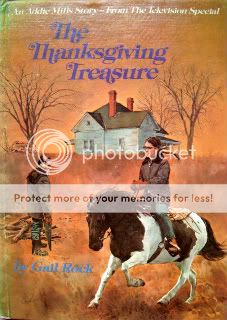


The Thanksgiving Treasure
Gail Rock, il. Charles C. Gehm
1974, Alfred A. Knopf, Inc.

I would have happily given up any member of my family or any friend, including Carla Mae, to have a horse, but the mere mention of the word was enough to guarantee an argument from my father. He had grown up on a farm, and he saw nothing thrilling about a horse. He simply did not respond to my fantasies of riding at a gallop across the plains beside Roy Rogers and Dale Evans.

In November of 1947, Adelaide "Addie" Mills is growing up in Clear River, Nebraska, population 1,500, with her widower dad and her grandmother. Her dad's a curmudgeon, and has a long-standing feud with another local crank, farmer Walter Rehnquist. Rehnquist is a semi- hermit who threatens people with his shotgun if they trespass on his farm at the edge of town. Addie's always been content to accept her dad's view on the matter of the feud, but a combination of the season of overtures and the discovery that Rehnquist owns a horse gives her an idea; the Pilgrims and the Indians became friends over a shared meal on the original Thanksgiving, so why not invite the family enemy to the holiday dinner? Her dad's reaction is predictable.

"Well, think again before you come up with another damn fool idea like that!"

She tries to shop the idea to her best friend, Carla Mae, whose large family, she argues, won't even notice an additional face at the table. When that fails, she pulls out all the stops and argues that if no one wants the old grouch at their table, they should take a Thanksgiving meal
to him. Carla Mae is not enthusiastic -

"You're crazy!" she said. "The only reason you want to go is to see that stupid horse!"

- but gives in. Addie sneaks food off the table and then the two ride their bikes off into the darkness of a Thanksgiving afternoon. Rehnquist grudgingly lets them in and samples the food, but cuts to the heart of Addie's motivation -

"I'm a pretty smart old gink," he said, "So don't fool around with me, sister. Tell me the truth!" "I told you, it's the spirit of Thanksgiving, and ... I was worried about your horse."

It turns out the pinto mare is named Treasure, and Rehnquist is on the fence about letting Addie ride her until she mentions that her father won't let her ride.

A very short, quick book which moves along more by virtue of atmosphere and character than plot. It's not really a horse book - Treasure, while a pivotal part of the plot, is not actually in most of it.

This book - and the series it was a part of - has an odd story. The book was an early example of a book based on a visual medium, in this case a TV movie which originally aired on CBS on November 18, 1973. The movie was released on VHS as The Holiday Treasure, packaged with the far better-known prequel The House Without A Christmas Tree. Addie's adventures are based on those of the author/screenwriter, Gail Rock, and continue for two more movies/books, both of them also holiday themed. A Dream For Addie (the book) aka The Easter Promise shows Addie idolizing a famous actress who returns to her hometown of Clear River, and in Addie And The King Of Hearts, Addie develops a crush on a teacher.

Links
IMDB for The Thanksgiving Treasure (1973)

Flying Dreams - a fan page for the film trilogy

Collecting Children's Books blog - the books
Roy Rogers website
Valley, Nebraska

Other Editions
1) A Bantam Book/Scholastic edition from 1976 (with, unfortunately, some writing on the cover)


2) A Dell Yearling edition (1986)

3) It also appeared in Redbook Magazine as a serial in November of 1974.


And the TV movie
The actress who plays Addie actually broke her leg falling from the horse during filming.


About the Author
Roberta Gail Rock (1940-____)
Rock grew up in Valley, Nebraska, which seems like a basic name even for the Midwest, and moved to New York to work in journalism. She worked as a film/TV critic for Women's Wear Daily, and did freelance writing.

Monday, March 15, 2010

Vicki And The Black Horse (1964)


Vicki And The Black Horse

Sam Savitt, author and illustrator

1964, Doubleday and Company


"I've never heard of anything like it. That black horse couldn't have impressed me more if he'd won a blue ribbon at Madison Square Garden. Standing out there like that - waiting for you to cut him free." He shook his head, scratching the back of his neck. "Beats me! The most remarkable thing was the confidence he had in you. Somehow he knew you would help him if he waited. And you didn't let him down!"


Vicki Jordan has just freed her father's black Thoroughbred, Pat, who she adores, from a tangle of barbed wire. The horse emerges unscathed because he doesn't panic, and Vicki's father is bemused by the bond between his daughter and his horse. Smilingly, he promises her that pony she's always dreamed of. And Vicki is silent. What she wants is Pat. The former racehorse had come to Random Farm sick and used up, and the girl had devoted herself to his care. But Dan Jordan can't see past his daughter's youth, and she seems destined to yearn for the big horse. Sucking it up, she decides to focus on the promised pony. When her very first buying expedition turns up a starving, neglected creature far too small for her, Vicki impulsively buys him to save him.


The mane was ragged and dragged along the ground. Vicki bent over and lifted it to reveal the shrunken neck and bony shoulder. She let her hand wander aimlessly over the scrawny hide stretched tight as a drum around the emaciated body. It was sticky, gray with grime, swarming with flies. She crouched down to examine the hairy legs and long, cracked hooves that badly needed trimming. There was an ache in her throat as her eyes took in the flanks that sucked inward and the hipbones that pushed outward, threatening to break through the skin. She stepped back and walked behind the pony, noticed the tent-shaped rump and the concave sides and the tail - long, greasy, knotted with burs.


Even half-dead, Jesse (as he comes to be called) is a firecracker. Vicki's macho older brother assumes, wrongly, that one football hero can easily handle one skin-and-bones Shetland; it won't be the first time someone underestimates the little animal. Exasperated by Jesse's trouble-making, escape artist ways, Vicki considers selling him. What stops her is Pat. The black horse, long the only equine on the farm, has fallen in love with Jesse. Surely, though, Pat will get over it if Vicki sells Jesse to a good home and buys herself a pony she can actually ride?


Although Savitt was primarily an artist, his writing is evocative and concise. The action sequences are clear and intelligent:


That first buck put Vicki astride his neck, the second pointed her wildly thrashing legs to the heavens. She came to earth on her backside as Jesse and the other ponies shot past in a shower of dust and flying hunks of dirt.


The plot moves unhurriedly but without excess, and the language is rich.


He would love a hot mash tonight - bran and oats and molasses and hot water made the most delicious-smelling concoction. She tasted it occasionally as a mother samples a dish before giving it to her baby.


Best of all, the ending is perfectly handled, with dual happy endings for humans and equines.


Drawbacks include a fair amount of sexism- Vicki idolizes her daddy and her older brother, a female neighbor has hysterics after a riding accident, forcing Mr. Jordan to sternly calm her - and a slight lack of character development in humans other than Vicki. There is a certain smugness to the adult male characters - they're pleasant men, but blithely obnoxious, as with Dan Jordan's belief that no one but him can ride Pat.


Animals

Giant Pat, aka Pat - black Thoroughbred gelding with a star

Jesse James the Outlaw, aka Jesse - black and white Shetland pony gelding

Rocky - Irish Setter

Teddy - goat


About the Author/Illustrator

1917-2000

Savitt wrote and illustrated dozens of books, and his portraits of horses and dogs are well-known. He lived on a farm in North Salem, New York, was married and had two children. He spent several years as the official artist for the U.S. Equestrian team. Several of his drawings are held at the National Sporting Library.


Links

Sam Savitt website

New York Times obituary

Horse Art Collection.com - Sam Savitt

National Sporting Library


Fiction written by Savitt

The Dingle Ridge Fox And Other Stories

Wild Horse Running

Midnight, Champion Bucking Horse

Step-A-Bit, The Story Of A Foal

A Horse To Remember

Vicki And The Black Horse

Vicki And The Brown Mare


Nonfiction written by Savitt

Draw Horses With Sam Savitt

The Art Of Painting Horses

Great Horses Of The U.S. Equestrian Team (with Bill Steinkraus)

One Horse One Hundred Miles One Day (about the Tevis Cup)
Rodeo Cowboys, Bulls And Broncos
Sam Savitt's True Horse Stories


Other editions:


Scholastic Apple paperback, 1989


Friday, March 20, 2009

Sire Unknown

Sire Unknown
Marjorie Reynolds, il. Lorence F. Bjorklund
1968, Macmillan

Ever since he was four, he had ridden this patient pony. Although it made him feel disloyal, he couldn't help thinking You're nearly old enough to die. When you die, I bet Dad will buy me a bigger pony or maybe a horse

Boots, the bay pony who stands patiently when his rider wants to dismount and tack up a sign, does die. He's shot by a careless hunter, and Jim Evans gets his horse. But although he's thrilled to get a real horse, he's embarassed by the pinto's cow-like spots and name The Guernsey, and quickly renames him Apache Warrior. This is a fairly typical bit of dreaming for Jim, who's also convinced himself that the rich people down the road are his real parents because his dad's a fertilizer salesman and doesn't make much money. Jim's dissatisfied with his position in life, and must learn that the rich people aren't very nice while his making-do parents are very worthy.

Marjorie Reynolds is a puzzle. Her books were illustrated by gifted artists, and were simple and effective narratives; this is one of the few that doesn't quite come off. But her main characters are often quite harsh and unappealing. Here, Jim is a snob who yearns to be a rich man's son, and who wants his own pony dead so he can get a new one. When he has a chance to get justice for his pony, he runs away instead. There is a nasty thread of hate toward fat kids in all of her books - here, the fat boy Tubby is well, named Tubby, and is described endlessly.

- Tubby's chubby face
- his small eyes sparkled between their folds of fat
- Tubby took a greedy bite... caramel oozed from the corners of his mouth
- The fat face turned and looked at him
- Jim thought of how fat and squashy Tubby was

The writing can be effective or terrible. At one point, Tubby is described as 'Strutting up with the rolling gait of a barrel," an image impossible to conjure as it's so clearly at odds. A barrel can't strut, it doesn't have legs.

Horses/Other Animals
Boots - light bay pony gelding
The Guernsey/Apache Warrior - 4 y/o brown and white pinto gelding
Barberry - brown AngloArab gelding, 15hh

Tigger - beagle
Tugger - beagle
Lucy - beagle
Penny - beagle
Weaky - beagle
Little Lucy - beagle
Tiny Tigger - beagle
Butch - beagle
Funny Face - beagle

Other Books
The Cabin On Ghostly Pond (1962)
A Horse Called Mystery (1964)
Dark Horse Barnaby ( 1967)
Keep A Silver Dollar (1967)
Ride The Wild Storm (1969)

Thursday, March 12, 2009

A Pony For Linda
C.W. Anderson, author and illustrator
1951, Macmillan Publishing Co., Inc.

Once she had a ride on a little pony in a ring. It was a lazy, sleepy little pony, but Linda loved it. She talked about it for many days afterwards.

And here you have the reason it was possible to read Anderson's work - filled with upper-middle-class girl children whose lives are bursting with stables and wise old grooms and racehorses and ponies - and not absolutely loathe and hate him. He made his characters burn with desire, and although their desire was always for more than we even bothered wanting - I just wanted a horse, most of his characters wanted the next Man O'War - it was impossible not to identify with the passion. And he gets little stuff right, like how much a pony ride means to a little girl who desperately wants a pony.

Of course, Linda has something even better - a promise from her daddy that when she turns seven, she'll get a pony. And, true to his word, he produces a little pinto pony. And Linda is a very happy little girl. As her riding improves, she attends her first horse show and makes a new friend.

Horses/Ponies/Other Animals
Joker - gray gelding
Dinah - horse
Daisy - black and white pony mare
Peter - pet rooster

Etc.
I've become fascinated by the tack in illustrations, something I never noticed as a child. Here, Daisy seems to be wearing a curb bit and a running martingale, as does the friend's pony at the horse show. Dinah, the horse belonging to Linda's mother, seems to wear a double bridle and running martingale, as does Joker, her father's horse. All wear the old-style jodhpurs with the billowing upper legs.

Other picture books by Anderson
Billy And Blaze
Blaze And The Gypsies
Blaze And The Forest Fire
Blaze Finds The Trail
Blaze And Thunderbolt
Blaze And The Mountain Lion
Blaze And The Indian Cave
Blaze And The Lost Quarry
Blaze And The Gray Spotted Pony
Blaze Shows The Way
Blaze Finds Forgotten Roads
Linda And The Indians
The Crooked Colt
Pony For Three
Lonesome Little Colt

Saturday, February 28, 2009

A Horse Like Mr. Ragman
Rachel Rivers-Coffey
1977, Scribner's (Scholastic)

My horse would be a deep bay with velvet black trim. People would get him mixed up with King. Or he'd be a bright star-faced sorrel, or maybe a dapper little gray with slate eyes and a soft, pinkish nose.

Elizabeth Mae "Chicken" Jiggsen spends every summer working at the seasonal riding school operated by Mrs. Nolly, and eating her heart out for her own horse to show at the big end-of-summer Highlands Horse Show. When she gets sick one year, her loving but inexperienced and working-class dad buys her a horse. Not the horse of her dreams, but a shaggy pinto almost small enough to be a pony. Elizabeth is horrified, and her resistance to the horse called Mr. Ragman continues right down to the big jumping class.

Only two strides away were the parallel rails. He planted his small hooves solidly in the soaked dirt and was moving slightly to the right when I guided him straight with the pressure of my knee. "Up, boy," I whispered along his neck, and the pinto tucked himself up neatly, flew in a gentle arc, and came down effortlessly.

An easy, natural style makes this a readable book, but the convoluted sentences and lack of detail or varying points of view give it a shallow feel. Elizabeth's frustration with the wealthy Eva and her longing for a big horse make her a sympathetic character, but her harsh dismissal of other people, including amiable fellow riders as well as the villains of the book, diminish her as a heroine. It could be explained as a realistic portrait of a young girl who hasn't learned much humility or kindness, but by the end of the book, she still doesn't seem to have changed much. Perhaps this is understandable, as her role model, Mrs. Nolly, is also petty and catty by turns.

"That's just it. There are two kinds of losing. There is losing when you deserve to, and losing when you don't deserve to. Mine is the second kind."

As the blacksmith Carver Coy notes, "She's always a good sport when she's winning."

Carver's the most appealing character in many ways, but even he stages a late comeback to be unappealing, bringing a horde of shelter dogs to run loose at the big horse show. To be adopted, of course, which is nice, but you can't help side with the vicious Garson Gambill when he protests that the dogs are a menace.

A very sour note comes at the end, when Gambill, who competes with Tennessee Walking Horses and drugs them to win, is finally punished. Fighting his suspension from showing, he cries out that he doesn't want to go back to hanging wallpaper for a living and threatens to sue; the horse show judge who suspended him doesn't just remind him it's his own fault, he pulls the class card to put the wallpaper hanger in his place, tranquilly remarking that he's quite wealthy and would be quite pleased if Gambrill sued him.

Horses
Mr. Ragman - pinto gelding
William Tell (aka Garrison's Quarter) - bay Thoroughbred gelding
Major - aging Thoroughbred
Benny - Tennessee Walking Horse
Beau
Jack
Stogy - sorrel filly
Daisy - mule

Setting
North Carolina, the mountain resort of Blowing Rock.

About the Author
Rachel Rivers-Coffey inherited a newspaper, the Watauga Democrat, in 1975. When she sold out in 1994, the paper had been in the Rivers family for 100 years. She died in 1999, at age 56, of injuries from a riding accident.

Themes
Rescue
OHDEARGODITSPINTO!!!!!
Horse Show
Why did my father buy me a horse?
Rescue

Monday, January 19, 2009

And now an English book for a change of pace.


Poor Badger
K.M. Peyton, il. Mary Lonsdale
1990, Doubleday

Ros Palfrey is horse-crazy but lacks opportunity until she spots a handsome pinto pony grazing in a park near her home. Completely around the bend about the pony but suspicious of his careless owners, she makes it her mission in life to look after Mountfitchet Meteor Light or, as she calls him, Badger. But despite her efforts, his owners' sloppy care slowly turns to neglect, and as winter approaches, Ros begins to believe that Badger will die of hunger and cold. So she hatches a plan...

Going home from school, the path led out of Safeway's parking lot and across a wide stretch of rough ground toward the railroad. It was spring, and the ground was greening happily, bright with dandelions and ­-

Ros stopped in her tracks and Leo, trailing, walked into the back of her.

"What?"

"Look!" Her voice quivered with glory. "Look!" It squeaked, out of control.

Leo looked. Usually the field was empty, except perhaps for an old man walking his dog, but today a pony was grazing in it, held by a chain fastened to a tether.

I am so jealous. I always wanted to find a pony tied out in a field by my town's supermarket. All I ever found was a turtle. Damn those English towns with their wacky commons and lack of proper zoning regulations, making Americans drool with envy.

A crisp and energetic book with a dreamy sidekick who comes into his own, a brave heroine, a realistic villain and an adorable pony. I would quibble that the heroine's parents are rather spineless when the pony's owner calls up to complain about their daughter's behavior. Her father's caution about it being chancey to draw the RSPCA's attention to the pony's condition seem more about reluctance to get involved than a real concern about the pony or his daughter. And the insistence on realism at the end was more labored than a traditional perfect ending would have been.

Did I mention the adorable pony? The cover makes that quite clear. The interior illustrations are less charming, being rather rough and doing a better job with the human faces than the pony.

Animals
Mountfitchet Meteor Light/Badger - black and white pinto pony gelding
Ermintrude/Erm - dog

Themes
Horse Show
Abuse
Rescue

Other Books
Flambards
Fly-By-Night
Flambards In Summer
The Team

Author Website


Sunday, January 11, 2009

Summer Pony (Jean Slaughter Doty, 1973)


When Ginny Anderson convinces her parents to lease her a pony for the summer, she never expects that her dream horse will be so - real. The first shock is the decrepit Sweetbriar Pony Farm, where her loving but unhorsey parents take her to select a pony. The second is the pony, a skinny pinto mare with mismatched eyes and a mind of her own. The third is the reality of caring for an animal who can die from overeating and fly into a lethal panic over a falling leaf. But as the Andersons learn about stable management and Ginny learns to ride, the summer becomes fun, especially when Ginny makes friends with a neighbor who also rides.

Summer Pony is impressive in its handling of a typical situation - a horsey child with unhorsey parents, and the problems that creates - in a solid, realistic manner that manages to be interesting and involving without resorting to the more spectacular adventures that many horse book rely upon. True, Ginny does conveniently makes friends with a wealthy, horsey neighbor girl whose family has an Irish stableman who is a ready source of information and help. But without a few useful coincidences, the heroes of pony books would be stuck doing what we did as kids - reading library books on the porch while wishing we had ponies.

Information-wise, Summer Pony is one of those that gives the hungry wannabe horse owner good food. Ginny's shown puzzling out how to bridle her new pony, learning the difference between bits, and other fascinating-to-horse-people arcana. Catnip.


Illustrator:
There is no separating this book from its illustrator. Sam Savitt's cover alone makes the book sing. The interior drawings are as alluring. Savitt's warm, safe style suits this book perfectly, and it is a beautiful marriage. The most recent edition unfortunately replaced Savitt's realistic cover painting with a cartoonish watercolor.

Other books by the author:
Winter Pony (sequel)
The Crumb
The Monday Horses
Can I Get There By Candlelight?
Yesterday’s Horses
If Wishes Were Horses
The Valley Of The Ponies
Dark Horse