Showing posts with label Illustrator - Lorence F. Bjorklund. Show all posts

Sunday, February 20, 2011

Cactus Kevin (1965)


Cactus Kevin
B. Holland Heck, il. Lorence Bjorklund
1965, The World Publishing Company

"A fellow on a farm has to have a horse."

It's 1944, and Kevin Bryson's parents have just moved the family from Tulsa to a farm (his dad, working at the Douglas Aircraft Company, a war industry, is presumably exempt from the draft). He's never been on a horse, and he has trouble remembering his new chores, but he loves being out in the country and once he sees a neighbor's palomino gelding, he's in love. The neighbor, a brat named Freddie, is notorious for mishandling his horse, which further inflames Kevin. But apart from the Bryson's lack of money, there's a problem in that the former city boy is fighting his parents' doubt that he is responsible enough to have a horse. From leaving the calf without water to teaching the rooster to fight, Kevin seems to constantly give his father a reason to be exasperated.


The family has problems apart from his wanting a pony they can't afford. Kevin's mother is struggling to maintain a primitive, rural house, while his father is discouraged by the sizable task of bringing a neglected farm back to life. Their worst problem is their well is dry, something the previous owner failed to mention. As the family slowly moves forward, digging a new well, buying calves, and learning the ins and outs of tractor control, Kevin is often too busy dealing with the new demands of farm life to long for a horse.

It rained again that night, making the ground muddier than ever. The Brysons scarcely knew how to cope with the mud. Dad said, "That's the blackest, stickiest, contrariest stuff I ever saw." Kevin thought both Dad and Mom seemed a little defeated by it. A variety of thin, straggly grass grew in the yard, but it didn't keep them out of the mud as their lawn grass in town had done. This grass pulled up by the roots with the mud, helping to hold the mud together that much tighter.

Kevin eventually gets his chance, Freddie gets his comeuppance, and the family triumphs over their early adversity. A very solid story about a family, but not particularly horsey as most of the book is about the family's struggles with the farm. I'm a sucker for tales about Black Angus calves, tractors and digging wells, but I was a bit disappointed, especially as the few really horsey scenes are flat. There is one hair-raising accident scene, which you can see coming the first time Freddie uses his horse to race the school bus.


Like most farm books, it does an excellent job of showing the dangerous side of farming; Kevin, who rides out the above rear without turning a hair, is terrified when his father's first ride on the new tractor nearly turns to tragedy.


Heck also does a nice job of presenting realistic characters. The mother isn't saintly or silly; the little sister is bratty but strong (and Kevin swings between "Awww, sis" reactions and doing things like building her the snow horse above), and the father can get discouraged and unreasonable. Perhaps reflecting the isolation of their ranch, there are few characters outside the family, apart from old Wrangler Slim, an old man living nearby who befriends them when Kevin, early on, wanders into a cactus patch, and who gives him his nickname.


About the Author
Bessie Holland Heck based this book on her own family's adventures, and Kevin was based on her son Ronald. She was married with five children, a freelance writer who lived in Tulsa and, during World War II, on an acreage just like the Bryson family's.


Other books
Millie (1961) (il. Mary Stevens)
The Hopeful Years (1964) (il. Lorence Bjorklund)
The Year At Boggy (1966) (il. Paul Frame) - adventures of farm workers' children
Captain Pete (1967) (il. Robert Cassell)
Golden Arrow (1981) - also horsey (il. Charles Robinson) (Scribner)
Cave-In At Mason's Mine (il., Charles Robinson) (Encore Editions)
Danger On The Homestead (1991) (Levite Of Apache Publishing)
Taming The Homestead (sequel to above)

The books after 1981 appear to have been published by a very small regional publisher, and little information is available on them. All the books appear to be juvenile fiction.

Links
de Grummond Collection
Ponymad Booklovers blog on Heck
Jane Badger Books about Heck
Catoosa, OK

Thursday, April 15, 2010

Ride The Wild Storm (1969)


Ride The Wild Storm

Marjorie Reynolds, il. Lorence F. Bjorklund

1969, The Macmillan Company


"Every time he gives a little cough, you rush to him as if he were dying."


12-year-old David Lang is frozen in indecisive nervousness between his impatient father and his sickly mother. His father rages at his mother's coddling, and his mother weeps at his father's brusqueness, and David basically tries to cut off the sound of their twin whining while dreaming of horses, but he's a worried kid. Worried about his parents, who are talking divorce, worried about his asthma, worried about being shunted off to Nantucket as a paid guest of a local family for the summer, worried about his mother's bronchitis and his father's blatant dissatisfaction.


On Nantucket, the Macy family startles and confuses David, who's not used to the freedom to come and go without adult scruntiny - or to the blithe assumption that everything's fine unless you're actually bleeding. The tightly wound kid begins to relax a little, but what really kick starts his change is the mare Salty. The Macys agreed to care for the grey mare and sell her for her owners, who have moved off the island, but in the meantime David can ride her. And the tense, frantically worried David seems to loosen up almost the moment he meets the horse.


"Let's ride bareback," he said, although he had never done such a thing in his life.


With Bill Macy and his pony Pumpkin for company, David and Salty explore Nantucket. David, experiencing childhood freedom of movement for the first time in his life, thrills to every adventure, from getting lost in a fog to rescuing stranded swimmers. Bill, more prosaic, reminds him that Salty, the key to their shared transportation, will be sold sooner or later.


Very much a boy adventure, with the focus being on how Salty gives David freedom and autonomy. There is much less fascination with the horse as a beautiful animal or to the care of the horse than in the typical horse book starring a girl. David dearly loves Salty, and there are passages where he reflects on her beauty or gentleness, but it is an emphatically male POV. In most horse stories, a girl rescues a horse; here, a horse rescues a boy.


Reynolds had a few quirks which made her books a bit aggravating - an obsession with fat kids, a tendency to portray women as either sturdy and contented second fiddles or as weak ciphers (with men as strong, sensible alpha males) and some unlikely language - has any 12-year-old boy after 1900 really uttered the word "shall" in a casual conversation? The language itself is slightly stilted; it's clear and readable, but a little simple for the presumed audience.


As opposed to that is her depiction of a wonderful childhood summer running free across a unique island, galloping bareback on the beach, rescuing hapless people and becoming strong and confident. She vividly portrays a sense of a summer idyll on horseback, and Bjorklund's soft, dreamy art complements her style.


Books

The Cabin On Ghostly Pond

A Horse Called Mystery

Sire Unknown

Dark Horse Barnaby

Keep A Silver Dollar

Ride The Wild Storm


Links

Nantuckett, Massachusetts


Thursday, April 8, 2010

Old Sam, Thoroughbred Trotter (1955)


Old Sam, Thoroughbred Trotter

Don Alonzo Taylor, il. Lorence F. Bjorklund

1955, Follet Publishing Company


This book is mostly about what happened after we got to our homestead in the Dakota Territory, but I guess I better begin before that and tell how we got Old Sam and how he came to be crippled.


John Scott is 7 when a stranger passes by his family's Mississippi farm with a beautiful grey trotter tied to the back of his buggy. The horse slips on a bridge and breaks a leg, but when the stranger asks John's father to loan him a gun to put the horse out of his misery, the Scott children beg him to reconsider. The owner, already heartbroken, agrees to give them the horse, who makes a partial recovery. He has a crooked and shortened leg and a limp, but he does get back the use of the limb. And for a crippled horse he's surprisingly useful, able to pull a plow and a buggy.


Three years later, in 1882, the family moves west, settling on 480 acres on the Dakota prairies, in a region then known as "The Great American Desert." The family is relatively well-off, and with 12 other horses to do the grueling work of breaking a prairie into cultivated land, the grey is left to his own devices.


But Sam was not idle. He was always on the go - all over the place. He didn't follow us like a dog any more than we did him, for there were times when he would attract my attention with a short whinny and I would see him standing in the distance, his head up and his ears cocked forward, looking in my direction. That could mean only one thing, and I would call to Lee, "Hey, Lee, come on! Sam is waiting for us." He was just one of us, and that is how we treated him.


The cousins John and Lee have various adventures, usually involving Sam.


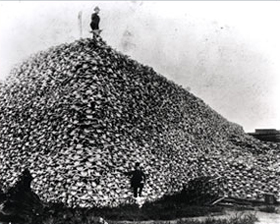
In the morning, a strange world was spread out before us. The day before, the prairie had been the light faded color of last-year's grass. But in the morning, as far as the eye could reach, the prairie was black as coal. No - not all of it was black. There was something else that attracted immediate attention. Standing out in sharp contrast to the black background were the white bones of thousands of buffaloes, a tragic reminder of the ruthless slaughter that had cleared the plains of these majestic animals in just a few years.


After a prairie fire, John and Lee get lost collecting buffalo bones (used back East as fertilizer and in sugar refineries) and Sam is called upon to find the route home. The horse does, reliable as a watch. But it's two years after the move that Sam moves back into his old world of racing. The boys, challenged by their family's conviction that their victory in an impromptu race was just a kind gesture by their adult opponents, secretly enter Sam in the Fourth of July trotting race against a field of adults driving sound, young horses, including the favorite, Chestnut Prince. When they get to the starting line, however, a combination of distaste for the spectacle of a crippled horse drawing a bulky farm wagon and an uneasy awareness that said crippled horse has a certain reputation for speediness provokes the other drivers to demands Old Sam's withdrawal. The cousins sadly comply, but when the starter shouts "Go!" Sam takes off.


This is far more a pioneer book than a horse book. The horse plays a recurring role and ties the stories together, but this was originally a series of stories the author told his children with the intention of recapturing his pioneer youth, and it's clear that his interest was largely in that experience. This in itself is an interesting story, of course, but it's a little disconcerting when you go in expecting a horsey book. The stories Taylor told his kids became a book when his grown daughter, Hazel Hohanshelt became a teacher and repeated the stories. Inspired by their interest, she began editing them into a book.


Note:

The book was reissued in 2008 under the title Old Sam: Dakota Trotter by Bethlehem Books.


About Don Alonzo Taylor

1872-?

Married Jennie Anderson in 1901, and moved to Oakes, North Dakota. They had four children. In 1924, they moved to California, settling in Alpine, near San Diego.


About Hazel Taylor

1905-2004

Married Forrest Hohanshelt and taught school in Alpine, California.


Links

On Google Books

Bethlehem Books

1882 Map of Dakota

Man standing atop mountain of buffalo bones

Buffalo bones being loaded onto train

Ellendale, North Dakota today

Alpine, CA Chamber of Commerce

Hazel Hohanshelt's obituary in the San Diego Union-Tribune


Books

Old Sam, Thoroughbred Trotter

Old Sam And The Horse Thieves (sequel)

Friday, March 20, 2009

Sire Unknown

Sire Unknown
Marjorie Reynolds, il. Lorence F. Bjorklund
1968, Macmillan

Ever since he was four, he had ridden this patient pony. Although it made him feel disloyal, he couldn't help thinking You're nearly old enough to die. When you die, I bet Dad will buy me a bigger pony or maybe a horse

Boots, the bay pony who stands patiently when his rider wants to dismount and tack up a sign, does die. He's shot by a careless hunter, and Jim Evans gets his horse. But although he's thrilled to get a real horse, he's embarassed by the pinto's cow-like spots and name The Guernsey, and quickly renames him Apache Warrior. This is a fairly typical bit of dreaming for Jim, who's also convinced himself that the rich people down the road are his real parents because his dad's a fertilizer salesman and doesn't make much money. Jim's dissatisfied with his position in life, and must learn that the rich people aren't very nice while his making-do parents are very worthy.

Marjorie Reynolds is a puzzle. Her books were illustrated by gifted artists, and were simple and effective narratives; this is one of the few that doesn't quite come off. But her main characters are often quite harsh and unappealing. Here, Jim is a snob who yearns to be a rich man's son, and who wants his own pony dead so he can get a new one. When he has a chance to get justice for his pony, he runs away instead. There is a nasty thread of hate toward fat kids in all of her books - here, the fat boy Tubby is well, named Tubby, and is described endlessly.

- Tubby's chubby face
- his small eyes sparkled between their folds of fat
- Tubby took a greedy bite... caramel oozed from the corners of his mouth
- The fat face turned and looked at him
- Jim thought of how fat and squashy Tubby was

The writing can be effective or terrible. At one point, Tubby is described as 'Strutting up with the rolling gait of a barrel," an image impossible to conjure as it's so clearly at odds. A barrel can't strut, it doesn't have legs.

Horses/Other Animals
Boots - light bay pony gelding
The Guernsey/Apache Warrior - 4 y/o brown and white pinto gelding
Barberry - brown AngloArab gelding, 15hh

Tigger - beagle
Tugger - beagle
Lucy - beagle
Penny - beagle
Weaky - beagle
Little Lucy - beagle
Tiny Tigger - beagle
Butch - beagle
Funny Face - beagle

Other Books
The Cabin On Ghostly Pond (1962)
A Horse Called Mystery (1964)
Dark Horse Barnaby ( 1967)
Keep A Silver Dollar (1967)
Ride The Wild Storm (1969)