Showing posts with label Breed - Standardbred. Show all posts

Thursday, April 8, 2010

Old Sam, Thoroughbred Trotter (1955)


Old Sam, Thoroughbred Trotter

Don Alonzo Taylor, il. Lorence F. Bjorklund

1955, Follet Publishing Company


This book is mostly about what happened after we got to our homestead in the Dakota Territory, but I guess I better begin before that and tell how we got Old Sam and how he came to be crippled.


John Scott is 7 when a stranger passes by his family's Mississippi farm with a beautiful grey trotter tied to the back of his buggy. The horse slips on a bridge and breaks a leg, but when the stranger asks John's father to loan him a gun to put the horse out of his misery, the Scott children beg him to reconsider. The owner, already heartbroken, agrees to give them the horse, who makes a partial recovery. He has a crooked and shortened leg and a limp, but he does get back the use of the limb. And for a crippled horse he's surprisingly useful, able to pull a plow and a buggy.


Three years later, in 1882, the family moves west, settling on 480 acres on the Dakota prairies, in a region then known as "The Great American Desert." The family is relatively well-off, and with 12 other horses to do the grueling work of breaking a prairie into cultivated land, the grey is left to his own devices.


But Sam was not idle. He was always on the go - all over the place. He didn't follow us like a dog any more than we did him, for there were times when he would attract my attention with a short whinny and I would see him standing in the distance, his head up and his ears cocked forward, looking in my direction. That could mean only one thing, and I would call to Lee, "Hey, Lee, come on! Sam is waiting for us." He was just one of us, and that is how we treated him.


The cousins John and Lee have various adventures, usually involving Sam.


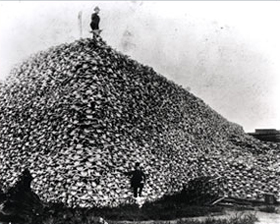
In the morning, a strange world was spread out before us. The day before, the prairie had been the light faded color of last-year's grass. But in the morning, as far as the eye could reach, the prairie was black as coal. No - not all of it was black. There was something else that attracted immediate attention. Standing out in sharp contrast to the black background were the white bones of thousands of buffaloes, a tragic reminder of the ruthless slaughter that had cleared the plains of these majestic animals in just a few years.


After a prairie fire, John and Lee get lost collecting buffalo bones (used back East as fertilizer and in sugar refineries) and Sam is called upon to find the route home. The horse does, reliable as a watch. But it's two years after the move that Sam moves back into his old world of racing. The boys, challenged by their family's conviction that their victory in an impromptu race was just a kind gesture by their adult opponents, secretly enter Sam in the Fourth of July trotting race against a field of adults driving sound, young horses, including the favorite, Chestnut Prince. When they get to the starting line, however, a combination of distaste for the spectacle of a crippled horse drawing a bulky farm wagon and an uneasy awareness that said crippled horse has a certain reputation for speediness provokes the other drivers to demands Old Sam's withdrawal. The cousins sadly comply, but when the starter shouts "Go!" Sam takes off.


This is far more a pioneer book than a horse book. The horse plays a recurring role and ties the stories together, but this was originally a series of stories the author told his children with the intention of recapturing his pioneer youth, and it's clear that his interest was largely in that experience. This in itself is an interesting story, of course, but it's a little disconcerting when you go in expecting a horsey book. The stories Taylor told his kids became a book when his grown daughter, Hazel Hohanshelt became a teacher and repeated the stories. Inspired by their interest, she began editing them into a book.


Note:

The book was reissued in 2008 under the title Old Sam: Dakota Trotter by Bethlehem Books.


About Don Alonzo Taylor

1872-?

Married Jennie Anderson in 1901, and moved to Oakes, North Dakota. They had four children. In 1924, they moved to California, settling in Alpine, near San Diego.


About Hazel Taylor

1905-2004

Married Forrest Hohanshelt and taught school in Alpine, California.


Links

On Google Books

Bethlehem Books

1882 Map of Dakota

Man standing atop mountain of buffalo bones

Buffalo bones being loaded onto train

Ellendale, North Dakota today

Alpine, CA Chamber of Commerce

Hazel Hohanshelt's obituary in the San Diego Union-Tribune


Books

Old Sam, Thoroughbred Trotter

Old Sam And The Horse Thieves (sequel)

Sunday, October 11, 2009

The Good Luck Colt (1953)


The Good Luck Colt

Genevieve Torrey Eames, il. Paul Brown

1953, Julian Messner, Inc.


Martin wasn't listening. He lifted the colt's head against his chest and rubbed its neck and sides. "Come on, little fellow," he whispered. "You're going to grow up and be a big horse someday - a trotter."


Martin Dennis loves trotting horses. His father breeds and trains Standardbreds, dreaming of one day reaching the harness world's biggest race, the Hambletonian, and Martin dreams right along with him. But while his father's hopes are pinned on the promising black colt Master Peter, Martin believes in his little orphan foal Good Luck. Since no one knows if his dam was registered, Good Luck's prospects for a trotting career are dim, but Martin is determined to make his colt a harness horse. He has some trouble -


It was not until he unsnapped the rope and picked up the lines that he ran into trouble. No matter how he tried he could not get Good Luck to walk away from him. Every time he stepped behind him and picked up the lines the colt turned and came toward him, nuzzling his hands and pockets for carrots or oats.


- but for the most part, Good Luck learns easily and Martin has high hopes of tracking down his dam's papers through a slippery horseman named Gus Brown. When tragedy strikes, Martin feels pressured to re-ignite his father's enthusiasm for horses, and suggests a trip to nearby Goshen to watch the harness world's biggest race, the Hambletonian. There, father and son meet the famous names of harness racing: Ben White, Bion Shively, Sep Palin, Harry Pownall, Fred Eagen, and watch the race itself. Upon their return home, matters with the elusive Gus reach a crisis, and Good Luck ends up racing for the first time.


A well-written, enjoyable old horse book with a vivid portrait of harness racing and beautiful Paul Brown illustrations. Martin's little brother Cal is a wonder of tough-hearted childhood; his favorite strategy when he's annoyed at his older brother is to hopefully suggest that someone or something is dead. Even the villain Gus Brown is drawn intriguingly; a skillful driver and careful horseman, he is described as having a weakness for crooked schemes, but an honesty about caring for his horses.


Horses

Voline - Standardbred mare

Lady Luck - Standardbred mare

Good Luck - bay Standardbred colt with white stripe (Lady Luck x Good Cheer)

Master Peter - black Standardbred colt (Voline x Master Mind)

Peter Volo - Standardbred stallion

Master Mind - Standardbred stallion

Florita - chestnut Standardbred filly


Real Horses

Iron Prince - brown Standardbred colt

Crystal Hanover - Standardbred filly in Hambletonian

Sharp Note - Standardbred colt in Hambletonian

Duke of Lullwater - Standardbred colt in Hambletonian

Hit Song - Standardbred colt in Hambletonian

Scotch Victor - Standardbred colt in Hambletonian

Peter Nibble - Standardbred colt in Hambletonian

Hardy Hanover - Standardbred colt in Hambletonian

Epicure- Standardbred colt in Hambletonian


Other

Tassle - Dalmation mascot


Links

The Hambletonian Society

The real 1952 Hambletonian

Photo of the winning heat


Bion Shively

There was a short documentary film on Bion Shively's victory,Old Man In A Hurry.


Alma Sheppard

Martin, arguing for the right to race his colt, uses Alma Sheppard as an example of a child who raced harness horses. In 1937, she drove Dean Hanover to a record 1:58.


Other books by the author

Pat Rides The Trail 1946 il. Dan Noonan

A Horse To Remember 1947 il. Paul Brown

Ghost Town Cowboy 1951 il. Paul Brown

Flying Roundup 1957 il. Lorence F. Bjorklund


Dog story

Handy Of The Triple S 1949 il. Paul Brown

Friday, July 3, 2009

Stall Buddies

Stall Buddies

Penny Pollock, il. Gail Owens

1984, G.P. Putnam's


The bidding was slow. And the prices were low. Too low for a filly from a fine family of trotters. Too low for a filly with a broad chest, a proud head and wide-set eyes. But it was just as the sparrows had said; no one wanted a horse, especially a trotter, that had "trouble" written on her sweat-stained coat.


A Standardbred racehorse named Scarlett is so tense she has trouble winning until new owners provide her with stable buddies. Rufus Jones the Third, a rooster, and Merabel, a goat, give the nervous filly the companionship that she's lacked, and ultimately help her win.


Cute beginner reader book with a pleasant plot and nice illustrations by Gail Owen.


About the Author

According to Penny Pollock's website, she was born Penelope Lee Morrow in Ohio in 1935, but spent much of her youth in the Philadelphia suburb of Swarthmore. She married Stewart Pollock in 1956, and had four children.


About the Illustrator

Gail Owens was born in Detroit in 1939. She began her career at advertising agencies in New York, later illustrating magazine articles and books. She did the illustrations for A Horse For XYZ by Louise Moeri.

du Grummond collection on Gail Owens